Burger King Cheeseburger Copycat Recipe: Flame-Grilled at Home
A thin, flame-grilled patty, one slice of American cheese, pickles, yellow mustard and ketchup on a toasted sesame bun: how to make two at home in 15 minutes.
This Burger King cheeseburger copycat makes two burgers in about 15 minutes once the grill is hot. You need a thin 2 oz (57 g) patty of 80/20 ground beef grilled over open flame at 450–500 °F (230–260 °C), one slice of American cheese, pickle chips, yellow mustard and ketchup on a toasted sesame seed bun. That is the official US build, according to Burger King’s nutrition page as reported by Tasting Table in August 2026. Burger King does not publish its recipe or its patty weight, so the quantities below are mine. The point of this burger is the smoke on a very thin patty. Skip the flame and you have made a different burger.
What’s in a Burger King cheeseburger: the official ingredients
A Burger King cheeseburger in the US is a flame-grilled beef patty, one slice of American cheese, pickles, yellow mustard and ketchup in a toasted sesame seed bun. No onion, no lettuce, no tomato, no mayo. Six components, and that’s the whole burger.
Official build (US, per bk.com via Tasting Table, August 2026)
- Toasted sesame seed bun
- Flame-grilled beef patty
- 1 slice American cheese
- Pickles
- Yellow mustard
- Ketchup
Burger King France lists the stack from top to bottom on its product page (checked October 10, 2026): sesame bun, mustard, ketchup, pickle slices, one slice of melted cheddar, flame-grilled beef, sesame bun. I use that order for the copycat. It’s the only one the chain actually spells out.
Which cheese is on a Burger King cheeseburger?
In the US, Burger King uses one slice of American cheese. In France, the official sheet lists one slice of melted cheddar (“cheddar fondu”), and the Swiss menu says the same. Neither formula is published, so a supermarket slice will be close, not identical.
My pick is deli or packaged American cheese, even if you live in France. It melts smooth without splitting into oil and curd, which is also why I use it in my Bacon King copycat recipe. On a 2 oz patty, a slice of block cheddar sweats fat before it has melted, so I don’t use it here.
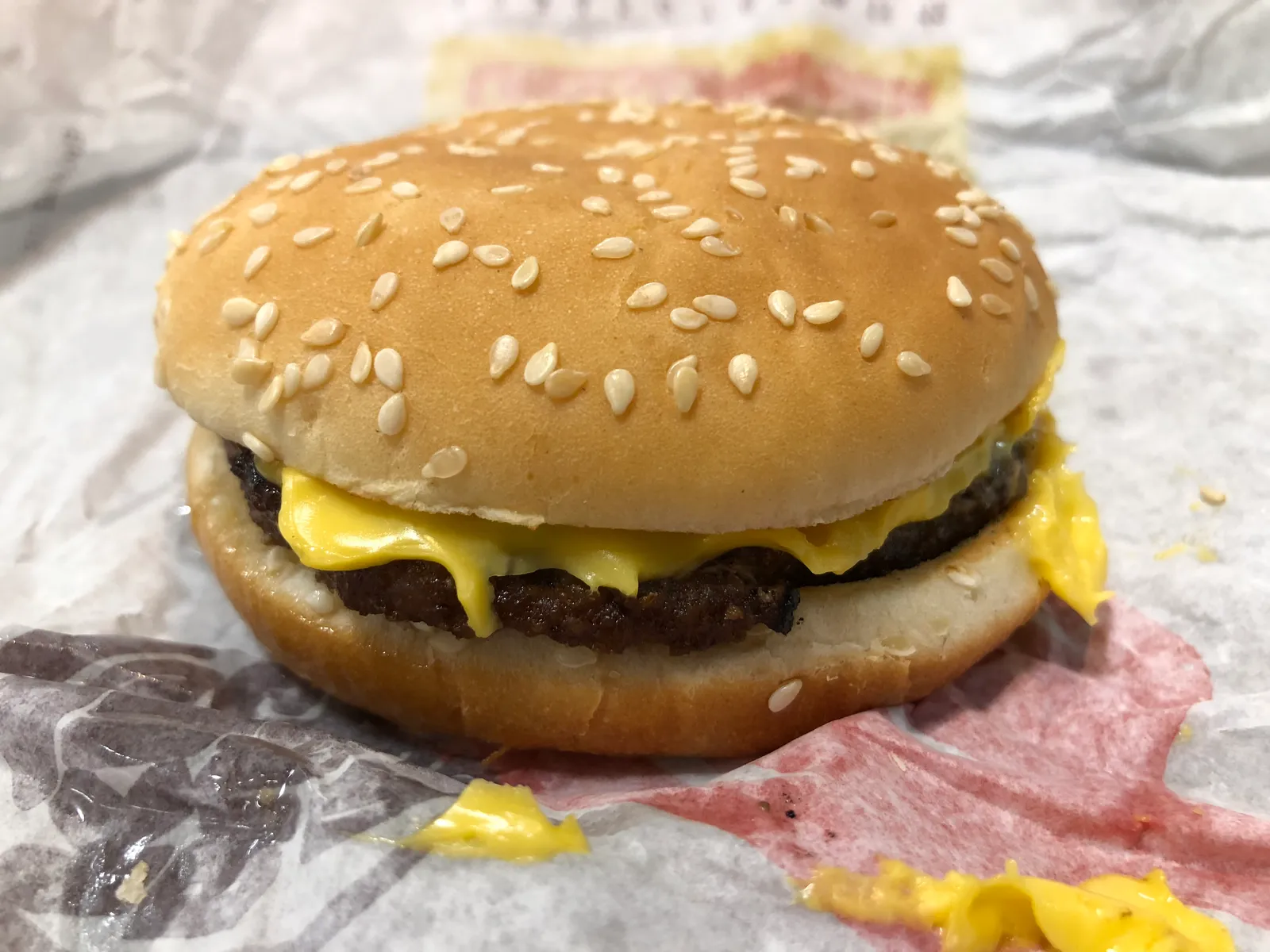
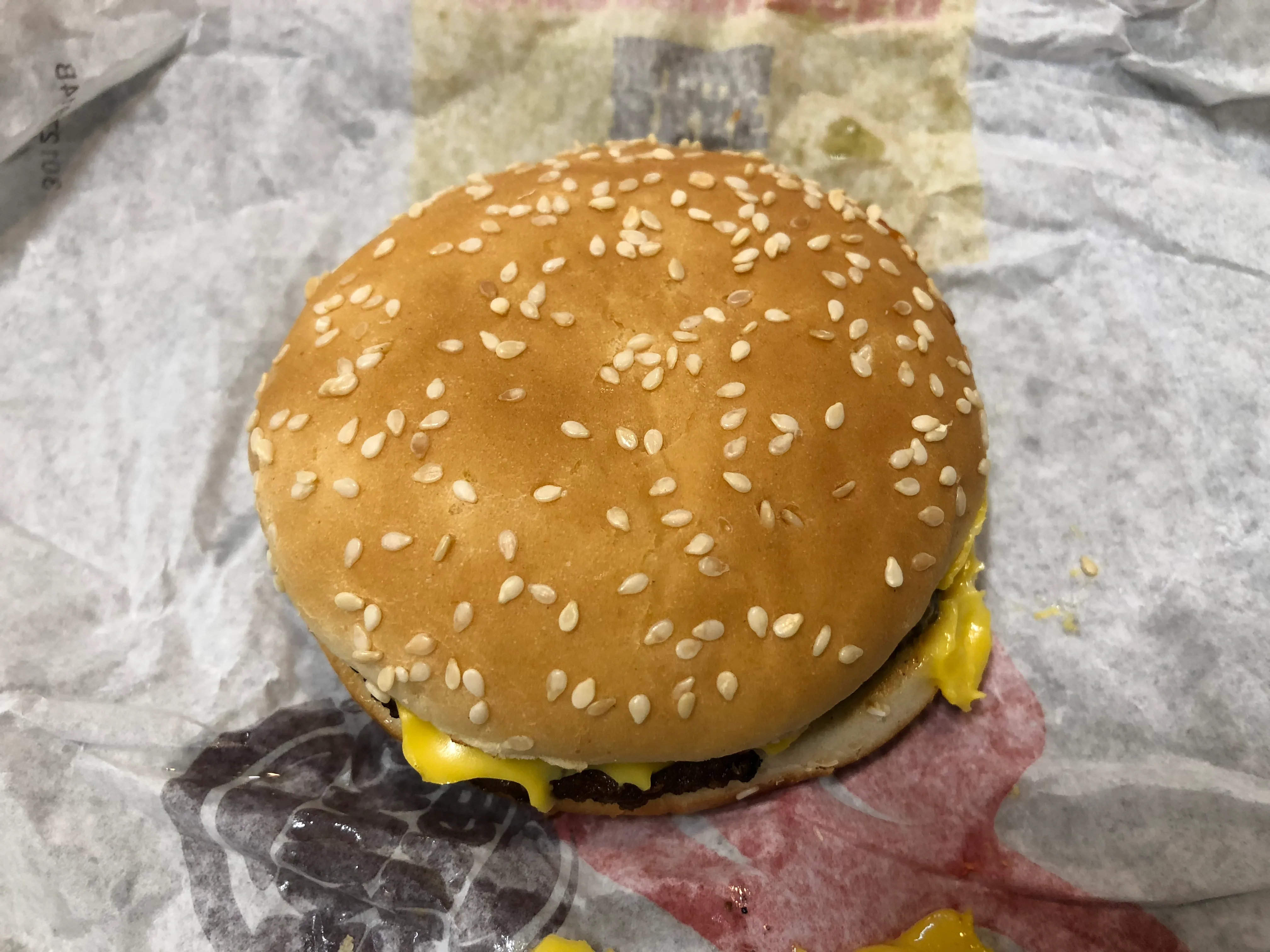 Top view of a US Burger King cheeseburger: the American cheese slice melts until it runs out from under the sesame bun, which is the texture to aim for with a deli American slice at home. (Photo: Famartin, CC BY-SA 4.0 (Wikimedia Commons, https://commons.wikimedia.org/w/index.php?curid=77250509))
How much does the Burger King cheeseburger patty weigh?
Burger King does not publish the weight of its cheeseburger patty, in the US or in France. Tasting Table compares it to a 2 oz (57 g) patty, and the CopyKat copycat shapes 1 lb of chuck into 8 patties, also about 2 oz each. That’s roughly half of the Whopper’s 4 oz (113 g) patty (Wikipedia).
So I use 2 oz (57 g) of 80/20 ground beef per burger. It’s my house choice, built from those benchmarks, not a leaked spec. Go heavier and you lose the thin, wide patty that makes this burger what it is.
Burger King cheeseburger copycat ingredients (2 burgers)
You need 4 oz (113 g) of 80/20 ground beef, 2 sesame seed buns, 2 slices of American cheese, 4 pickle chips, yellow mustard and ketchup. The quantities are mine; the components are Burger King’s.
- 4 oz (113 g) ground chuck, 80/20, cold
- ⅛ teaspoon fine salt
- 1 pinch black pepper
- 2 sesame seed buns
- 2 teaspoons (10 g) softened butter, for toasting
- 2 slices American cheese
- 4 dill pickle chips (2 per burger)
- 1 teaspoon yellow mustard (½ per burger)
- 2 teaspoons ketchup (1 per burger)
The seasoning follows CopyKat’s ratio of ½ teaspoon of salt and ¼ teaspoon of pepper per pound. Burger King does not say how, or whether, it seasons its patties. For soft buns that hold up to the grill, my homemade burger buns recipe works with sesame on top.
Prep time: 10 minutes · Cook time: about 5 minutes · Total: 15 minutes (plus preheating the grill) · Yield: 2 cheeseburgers
Step by step: how to make a Burger King cheeseburger at home
Shape two thin 2 oz patties, grill them over direct high flame to 160 °F (71 °C) inside, melt the cheese on top, then stack in Burger King’s order. Weigh the beef. Equal patties finish at the same time.
1. Shape the patties
Divide the cold beef into two 2 oz (57 g) portions and press each into a thin, flat disc a little wider than the bun. Thin patties shrink on the grill and should end up the same width as the bun. Keep them in the fridge until the grill is ready.
2. Heat the grill to 450–500 °F (230–260 °C)
Set a charcoal or gas grill for direct high heat, between 450 and 500 °F (230 and 260 °C). Clean and oil the grates. A small flare-up when the fat drips is good news: that’s where the smoky edge comes from. Below 450 °F, my patties went gray before they took any color.
3. Toast the buns
Butter the cut sides of the buns and toast them at the edge of the grill for about 30 seconds, until golden. CopyKat uses the same 30 seconds. Wrap them in foil to keep them warm.
4. Grill the patties
Season both sides with the salt and pepper just before grilling. Grill directly over the flame for 1½ to 2 minutes per side, flipping once, until an instant-read thermometer reads 160 °F (71 °C) in the center. Don’t press them. You squeeze out juice and feed the flames. If your grill runs cooler and the cook creeps toward 2½ minutes per side, the patty dries out, so turn the heat up rather than leaving it on longer.
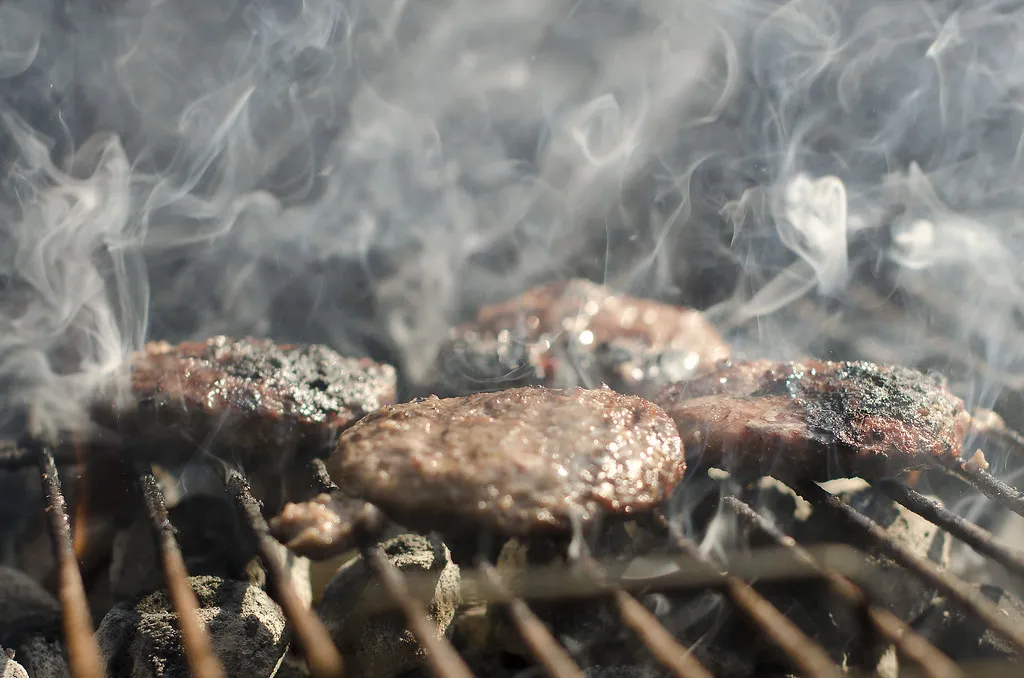 Thin beef patties searing over a hot charcoal grill. Smoke from the dripping fat gives the flame-grilled Burger King taste at home; grill 1½ to 2 minutes per side at 450–500 °F until the center reaches 160 °F. (Photo: Valters Krontals, CC BY 2.0 (Flickr, https://www.flickr.com/photos/53442856@N06/7668772348))
5. Melt the American cheese
Lay one slice of American cheese on each patty for the last 30 to 60 seconds and close the lid. The slice should soften and drape over the edges without running off.
6. Assemble in Burger King’s order
Place the patty and cheese on the bottom bun. Add 2 pickle chips, then 1 teaspoon of ketchup and ½ teaspoon of yellow mustard, and close with the top bun. Wrap each burger in parchment or foil for one minute. Don’t skip this: the steam softens the bun the way the paper wrapper does at the counter, and without it the burger tastes homemade in the wrong way.
How to get the flame-grilled taste of Burger King at home
The flame-grilled taste comes from cooking the patty right over an open flame, so a charcoal or gas grill at 450–500 °F is the closest you can get at home. Burger King uses a conveyor broiler that carries patties over gas flames, with preset times and temperatures.
A cycle takes about 2 to 4 minutes, and one Duke machine cooks 12 burgers or 8 Whoppers in 4 minutes, according to Tasting Table and Food Republic. The chain doesn’t publish the exact settings, so my temperatures and timings are home recommendations, not Burger King’s. I go deeper into the broiler in my guide to Whopper ingredients and the Whopper copycat recipe.
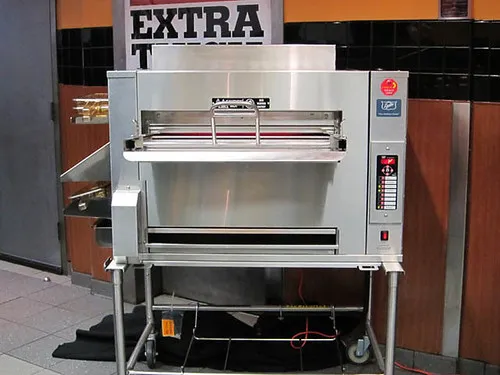 A Burger King conveyor broiler, shown at a 2010 press preview. Patties ride a chain over gas flames with preset times and temperatures, and a cycle takes about 2 to 4 minutes. (Photo: Jason Lam, CC BY-SA 2.0 (Flickr, https://www.flickr.com/photos/93512023@N00/4426527450))
- Charcoal or gas grill (best): direct high heat, 450–500 °F (230–260 °C), lid open while searing.
- Cast-iron skillet or grill pan: get it very hot. You get a dark sear but not the smoky char of an open flame. Side by side, the pan burger tasted more like a diner burger than a Burger King one.
- Oven broiler: heat comes straight down from the element. Put the patties on a rack close to it and stay at the oven, because thin patties cook fast. Check for 160 °F (71 °C).
For more on doneness and beef blends, see my burger patty guide to internal temperature and cooking methods.
Official vs. homemade: the comparison table
My copycat keeps every component of the official build and only adds the numbers Burger King doesn’t publish. Here’s what comes from the chain and what’s my call.
| Component | Burger King US (official) | Burger King France (official) | My homemade version |
|---|---|---|---|
| Bun | Toasted sesame bun | Sesame seed bun | Sesame bun, buttered and toasted 30 s |
| Patty | Flame-grilled beef, weight not published | Flame-grilled beef, weight not published | 2 oz (57 g) 80/20 beef, grilled to 160 °F |
| Cheese | 1 slice American cheese | 1 slice melted cheddar | 1 slice American cheese |
| Pickles | Pickles | Pickle slices | 2 dill pickle chips |
| Sauces | Yellow mustard, ketchup | Mustard, ketchup | ½ tsp yellow mustard, 1 tsp ketchup |
| Seasoning | Not published | Not published | Salt and pepper |
Official Burger King cheeseburger build (US and France) vs. the homemade copycat: bun, 2 oz (57 g) flame-grilled patty, American cheese, pickles, yellow mustard and ketchup. (Table: Burger Breton, data from Burger King France (burgerking.fr, checked October 10, 2026) and bk.com via Tasting Table (August 2026))
Burger King cheeseburger calories and nutrition
A Burger King cheeseburger has 300 calories in the US and 305 kcal in France. The US figures come from bk.com as reported by Tasting Table (August 2026), the French ones from burgerking.fr (checked October 10, 2026).
| Per burger | US (bk.com via Tasting Table) | France (burgerking.fr) |
|---|---|---|
| Calories | 300 | 305 kcal |
| Fat | 14 g | 13 g (5.9 g saturated) |
| Carbohydrates | 30 g | 29 g |
| Sugars | 7 g | 6.2 g |
| Protein | 16 g | 16 g |
| Sodium / salt | 810 mg sodium | 1.7 g salt |
Burger King cheeseburger nutrition per burger: 300 calories, 14 g fat, 30 g carbs, 16 g protein and 810 mg sodium in the US, against 305 kcal and 1.7 g salt in France. (Table: Burger Breton, data from Burger King France (burgerking.fr, checked October 10, 2026), Burger King Switzerland and bk.com via Tasting Table)
Burger King France also gives values per 100 g (259 kcal). Divide one column by the other and the French burger comes out at about 118 g. That’s my arithmetic, not a published weight; Open Food Facts lists 115 g. In Switzerland, the chain lists a 124.5 g cheeseburger with 335 kcal. Same name, a different burger in each country. I haven’t calculated nutrition for the homemade version.
Burger King cheeseburger calories by country: 300 in the US, 305 kcal in France and 335 kcal in Switzerland, where the published burger weighs 124.5 g. (Chart: Burger Breton via QuickChart, data from burgerking.fr, burger-king.ch and bk.com via Tasting Table)
Fat and protein in a Burger King cheeseburger: 14 g fat and 16 g protein in the US, 13 g and 16 g in France, and 15.2 g and 18.3 g in the larger Swiss burger. (Chart: Burger Breton via QuickChart, data from burgerking.fr, burger-king.ch and bk.com via Tasting Table)
Why this recipe tastes like the original
This copycat tastes like a Burger King cheeseburger because it keeps the three things that define it: a thin patty cooked over an open flame, a slice of fully melted American cheese, and the sharp mustard, ketchup and pickle trio. Change one and you drift toward a generic diner burger. The one-minute wrap at the end does the rest.
- Thin patty, open flame. At 2 oz, the patty is mostly surface, so the char reaches every bite.
- Melted cheese. Burger King reportedly makes sure the cheese melts all the way. One employee quoted by Tasting Table said the bun heel and patty go through a microwave called the ‘Hopper’, because patties cool in the holding bins. That’s one employee’s account, not an official procedure. Closing the grill lid gets you the same full melt.
- Yellow mustard and ketchup together. Mustard’s tang against sweet ketchup is the US flavor signature, with pickles for acid and crunch. Of the three, mustard matters most. Leave it out and the burger turns flat and sweet.
- Wrap and rest. One minute in paper steams the bun soft, like the takeout version.
A short history of the Burger King cheeseburger
Burger King has sold cheeseburgers since it opened in 1953 as Insta-Burger King in Jacksonville, Florida. The Double Cheeseburger arrived in 1976 and the Bacon Double Cheeseburger in 1982 (Wikipedia).
According to Food Republic, the 1953 menu priced burgers and shakes at 18 cents and the cheeseburger at 23 cents. For the chain’s bigger flame-grilled builds, try my Ultimate Double Whopper copycat and Triple Whopper with Cheese copycat. This year’s menu changes are covered in the Burger Breton news story on the new Burger King Whopper in 2026.
Burger King cheeseburger FAQ
Does the Burger King cheeseburger have onions or lettuce? No. The official US build is a patty, American cheese, pickles, yellow mustard and ketchup on a sesame bun. The French product sheet doesn’t list onion or lettuce either.
What are the allergens in a Burger King cheeseburger? In France, Burger King declares celery, mustard, sesame seeds, milk and gluten, with possible traces of soy, tree nuts and eggs. Check the allergen page for your own country, because recipes vary by market.
What’s the difference between the Cheeseburger, the Double Cheeseburger and the Whopper with Cheese? The Double Cheeseburger, launched in 1976, has two patties instead of one. The Whopper is built on a 4 oz (113 g) patty in the US, about twice the cheeseburger’s. Its full build is in my Whopper copycat guide.
Is the Burger King cheeseburger on the kids’ menu? Yes in France: the Cheeseburger is one of the choices on the King Junior menu for ages 4 to 7, with the same build (burgerking.fr).
Can I make the patties ahead and freeze them like Burger King? Yes. Burger King loads its patties into the broiler frozen. At home, shape the 2 oz patties, separate them with parchment and freeze them flat. Cook them to 160 °F (71 °C) in the center, frozen or not.
Can I use cheddar instead of American cheese? Yes, if you want the French version, which lists melted cheddar. A processed cheddar slice melts best. Aged block cheddar turns oily on a patty this thin.
More fast-food cheeseburger copycats
Next, try my Five Guys cheeseburger copycat with its double patty and free toppings, or the Dairy Queen Original Cheeseburger copycat. Every tested recipe is on the Burger Breton burger recipes hub.