
Homemade Burger Buns: Soft Brioche Buns Recipe
Tested homemade burger buns recipe: 8 golden, pillowy brioche buns in 3 hours, with exact weights, proofing times and oven temperatures in °F and °C.
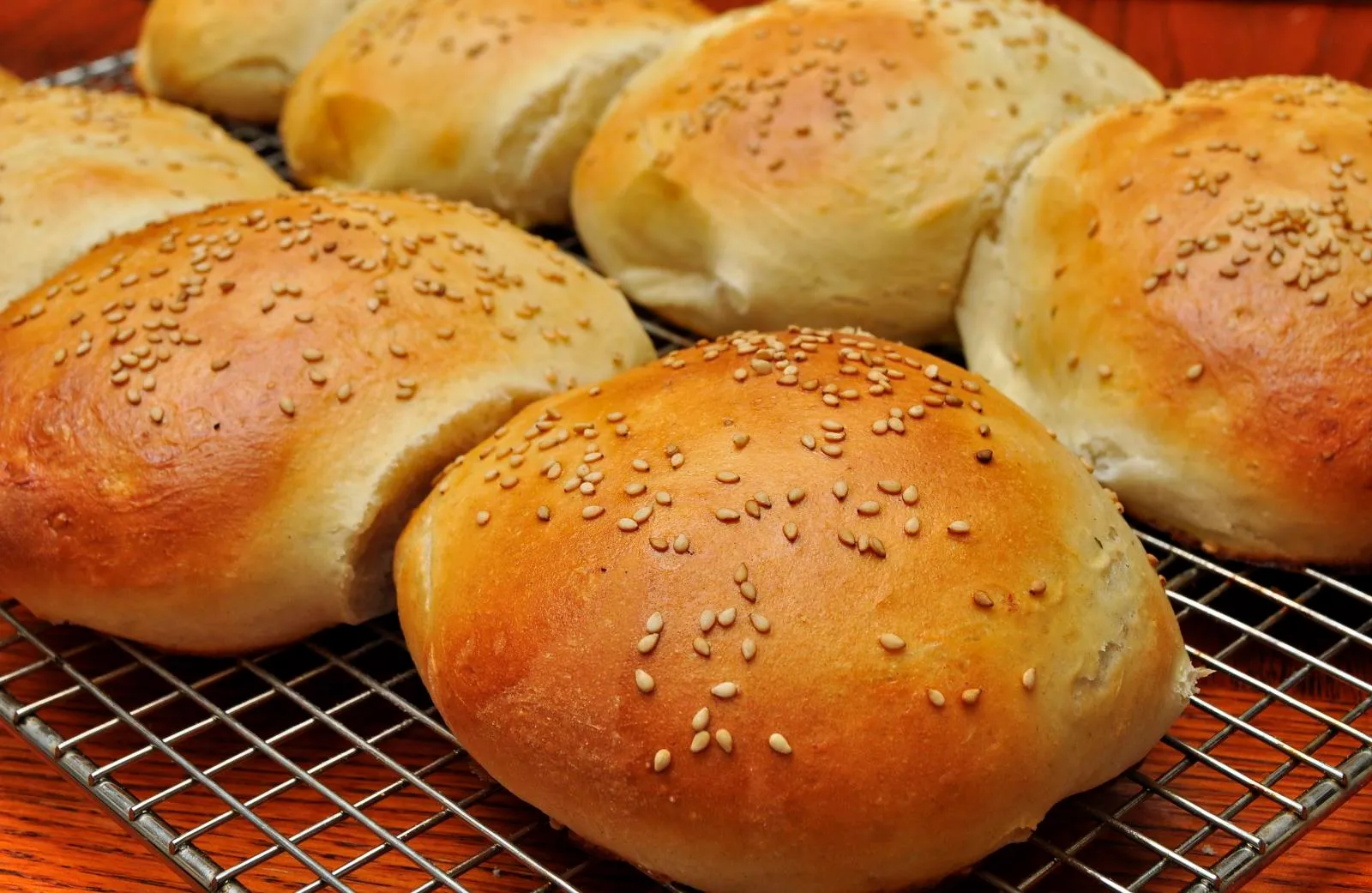
A good homemade burger bun is a brioche-style bun: a milk, egg and butter dough kneaded until elastic, proofed twice and baked 15 to 18 minutes at 350 °F (180 °C). From 4 cups (500 g) of flour you get 8 buns of 3.7 oz (105 g), golden, pillowy and sturdy enough to hold a 5 oz (150 g) patty, melted cheese and sauce without tearing. Plan on 3 hours in total, about 30 minutes of it hands-on.
I have made this recipe a good dozen times in my kitchen, adjusting the butter ratio and the proofing times until the bun held together like the ones served at a great burger joint while staying as soft as a brioche. Every temperature is given in both Fahrenheit and Celsius.
Ingredients for 8 burger buns
For 8 burger buns of 3.7 oz (105 g) you need 4 cups (500 g) all-purpose flour, 1 cup (250 ml) milk, 1 packet (7 g) instant yeast, 2½ tablespoons (30 g) sugar, 2 teaspoons (10 g) salt, 1 egg and 3½ tablespoons (50 g) butter.
| Ingredient | For 8 buns | For 12 slider buns (2.5 oz / 70 g) |
|---|---|---|
| All-purpose flour | 4 cups (500 g) | 4 cups (500 g) |
| Whole milk, warm, 82 °F (28 °C) | 1 cup (250 ml) | 1 cup (250 ml) |
| Instant dry yeast | 2¼ tsp (7 g, 1 packet) | 2¼ tsp (7 g) |
| Granulated sugar | 2½ tbsp (30 g) | 2½ tbsp (30 g) |
| Fine salt | 2 tsp (10 g) | 2 tsp (10 g) |
| Large egg | 1 (2 oz / 55 g) | 1 |
| Unsalted butter, softened | 3½ tbsp (50 g) | 3½ tbsp (50 g) |
| Egg wash: yolk + milk | 1 yolk + 1 tbsp | 1 yolk + 1 tbsp |
| Sesame seeds | 2 tbsp | 2 tbsp |
All-purpose flour gives the softest bun. Bread flour works too, with a slightly chewier crumb. If you use fresh yeast, use 0.7 oz (20 g) and crumble it into the milk. Weigh the flour if you can: a scooped cup can hold 20 % more than a spooned one.
Equipment
No stand mixer is required: a kitchen scale, a large bowl, a baking sheet, parchment paper and a pastry brush are enough.
A stand mixer with a dough hook saves 10 minutes of kneading. An instant-read thermometer is the one tool that really changes the result: it lets you check the milk temperature and the internal temperature of the buns.
The recipe step by step
Burger buns come together in 9 steps: activating the yeast, kneading, first rise, dividing and shaping, second proof, egg wash, baking and cooling.
1. Activate the yeast
Warm the milk to 82 °F (28 °C): it should feel barely warm on your finger. Above 113 °F (45 °C) the yeast dies. Stir in the yeast and sugar and wait 10 minutes. Foam should form on the surface. If nothing happens, the yeast is dead: start over with a fresh packet rather than waste 4 cups of flour.
2. Knead the dough
Mix the flour and salt in the bowl. Pour in the yeasted milk and the egg, then stir until no dry flour remains. Knead for 5 minutes: the dough is sticky at this stage, which is normal.
Add the softened butter in three additions, waiting for each to be absorbed before adding more. Knead another 8 to 10 minutes by hand (5 to 6 minutes in a mixer on medium speed). The dough is ready when it is smooth, glossy, and a piece stretched between your fingers forms a thin membrane without tearing: the windowpane test.
3. First rise: 1 to 1½ hours
Shape the dough into a ball, place it in the lightly oiled bowl and cover with a damp towel or plastic wrap. Let it rise at 75–79 °F (24–26 °C) until doubled: 1 hour in a warm kitchen, 1½ hours in winter.
No warm spot? Put the bowl in the turned-off oven with a bowl of boiling water next to it. The temperature climbs to around 86 °F (30 °C) and the rise takes 45 minutes.
4. Divide and shape
Punch the dough down, then weigh out 8 pieces of 3.7 oz (105 g). The scale matters: buns of equal weight bake at the same pace. To shape, fold the edges of each piece toward the center, flip it over and roll it under a cupped palm on an unfloured counter until you have a smooth, taut ball.
Flatten each ball slightly to 3 inches (8 cm) across. Skip this step and the buns bake into domes that let the patty slide off.
5. Second proof: 45 to 60 minutes
Set the buns on the parchment-lined sheet, 2 inches (5 cm) apart. Cover loosely and proof 45 to 60 minutes. They should grow by about 80 %, not double: over-proofed dough collapses in the oven. A simple test: a finger pressed into the side leaves a dent that springs back slowly.
6. Preheat and brush
Preheat the oven to 350 °F (180 °C) on convection, or 375 °F (190 °C) in a conventional oven, rack in the middle. Beat the egg yolk with the tablespoon of milk and brush the buns with a thin, even coat, without letting it drip onto the sheet. Sprinkle with sesame seeds.
Yolk alone gives a glossy, mahogany-brown crust. A whole beaten egg gives a paler, more matte color.
7. Bake 15 to 18 minutes
Bake for 15 to 18 minutes. The buns are done when the crust is evenly golden and the internal temperature reaches 200–205 °F (93–96 °C). Without a thermometer, tap the bottom: it should sound hollow. If the tops brown too fast, tent with foil for the last 5 minutes.
8. Cool before slicing
Cool 30 minutes on a wire rack. Sliced hot, the buns squash and the crumb turns gummy. Just before serving, toast the cut side 1 to 2 minutes in a skillet with a knob of butter until golden: that is what keeps the bun from soaking up the sauce.
Times and temperatures at a glance
| Step | Time | Temperature |
|---|---|---|
| Milk for the yeast | 10 min | 82 °F (28 °C) |
| Kneading | 13 to 15 min | Room temperature |
| First rise | 1 to 1½ h | 75–79 °F (24–26 °C) |
| Shaping | 10 min | Room temperature |
| Second proof | 45 to 60 min | 75–79 °F (24–26 °C) |
| Baking | 15 to 18 min | 350 °F (180 °C) convection, 375 °F (190 °C) conventional |
| Baked bun, inside | — | 200–205 °F (93–96 °C) |
| Cooling | 30 min | On a wire rack, room temperature |
Storing and freezing
The buns keep 2 days in a paper bag inside a sealed plastic bag at room temperature, and 3 months in the freezer.
Freeze them whole or already split, fully cooled, in an airtight bag. To reheat, put them straight from the freezer into a 300 °F (150 °C) oven for 5 minutes, or toast the cut sides in a skillet. Avoid the refrigerator: it dries out the crumb overnight.
Mistakes that give flat or dry buns
A flat burger bun almost always comes from dead yeast, too little kneading or an over-long second proof.
- The milk was too hot. Above 113 °F (45 °C) the yeast dies and nothing rises. Aim for 82 °F (28 °C).
- The dough was under-kneaded. Without a gluten network the crumb stays dense and the bun crumbles. Do the windowpane test before the first rise.
- The buns over-proofed. Doubled instead of 80 % bigger, they sag in the oven and give a coarse crumb.
- The oven was too hot. At 430 °F (220 °C) the crust colors in 8 minutes while the inside is still raw. Stay at 350 °F (180 °C) on convection.
- The buns were sliced hot. Trapped steam makes the crumb gummy. Wait 30 minutes.
Variations
The same dough makes buttermilk buns, potato buns or slider buns by changing a single ingredient or the weight of the pieces.
- Potato bun. Replace ¾ cup (100 g) of flour with ⅔ cup (150 g) of cold, plain mashed potato. The crumb turns moister and the bun stays soft for 3 days.
- Buttermilk buns. Swap the whole milk for buttermilk at the same 82 °F (28 °C): a slight tang and an even more tender crumb.
- Slider buns. Weigh out 12 pieces of 2.5 oz (70 g), flatten to 2½ inches (6 cm) and bake 12 to 14 minutes at 350 °F (180 °C).
- No sesame. Use poppy seeds instead, or leave the crust bare for a smash burger style bun.
Frequently asked questions
What flour is best for burger buns?
All-purpose flour gives the softest bun. Bread flour works too, with a slightly chewier, tighter crumb. Avoid whole wheat on its own: it weighs the dough down and hampers the rise.
Can I make the dough the day before?
Yes. After kneading, cover the bowl and refrigerate it at 39 °F (4 °C) overnight: the first rise happens slowly in the cold. The next day, shape the cold dough, proof the buns 1¼ hours at room temperature and bake as usual.
Can I make burger buns without eggs?
Yes. Replace the egg with an extra 3½ tablespoons (50 ml) of milk in the dough, and brush with milk alone or milk mixed with maple syrup. The bun will be a little less rich and less golden.
How long do homemade burger buns keep?
Two days at room temperature in a sealed bag, and three months in the freezer. Reheat them 5 minutes at 300 °F (150 °C) before serving.
Why are my buns flat?
Either the yeast died (milk above 113 °F / 45 °C) or the dough over-proofed during the second proof. In both cases the bread has no strength left to rise in the oven.
Once your buns are dialed in, move on to the filling: all our burger recipes give weights and cooking temperatures with the same precision.
Cover photo: jeffreyw, “Mmm… hamburger buns”, CC BY 2.0, via Wikimedia Commons.