Veggie Burger Recipe: Firm Black Bean Patties
A ratio-based method for a homemade veggie burger that sears, stays firm and gets its protein from beans, with numbers from USDA data.
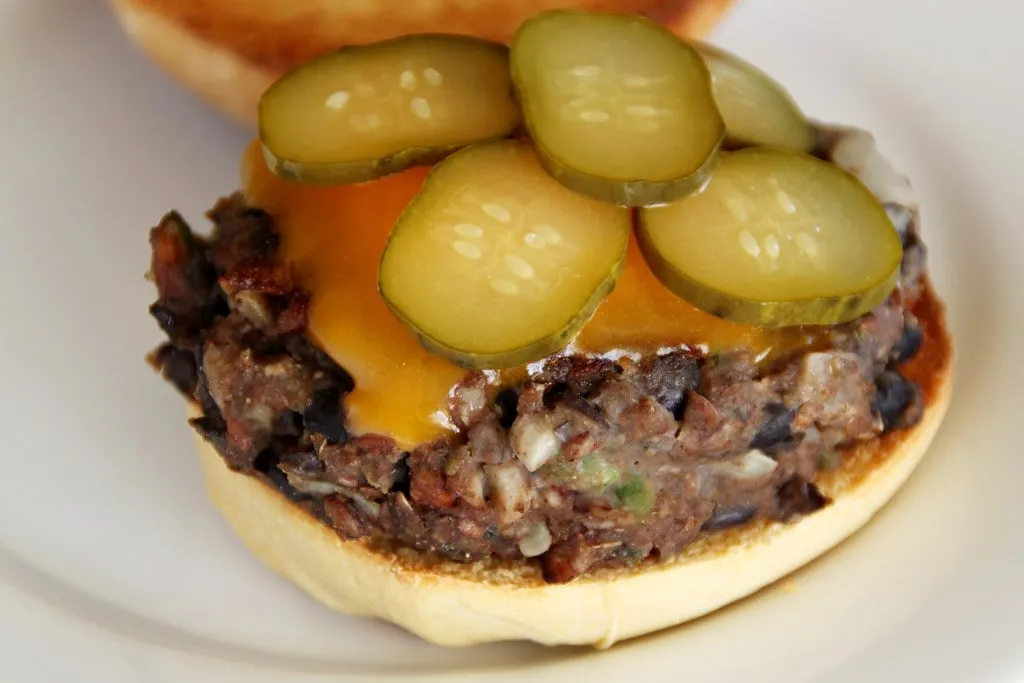
Photo: Stacy Spensley, CC BY 2.0
This veggie burger recipe makes a black bean patty that holds together in the pan and isn’t mushy inside. You need 300 g (10.6 oz) cooked black beans, 200 g (7 oz) cooked sweet potato and 120 g (4.2 oz) cooked brown rice, plus breadcrumbs to bind. Dry the beans in a 350 °F (175 °C) oven for about 20 minutes, mash everything, chill for 30 minutes, shape 120 g patties and sear them. The base has no egg, so it works as a vegan burger too, and the beans and rice alone give each patty about 6 g of protein.
Most veggie burger recipes stop at the ingredient list. They never tell you why a patty crumbles or turns to paste, and that’s what I wanted to find out. So this is a method: a ratio of beans to starch to binder, the drying step that fixes texture, protein numbers for each base and a troubleshooting table. My position after reading the recipes that rank: the binder gets far too much attention. Water is the real enemy, and the oven is the cure. The beef versions are in our homemade burger recipes.
The veggie burger formula: beans, starch, binder
A good veggie burger patty is mostly cooked legumes, held together by a cooked starch and adjusted with a dry binder. The legumes bring protein and flavor. Sweet potato and brown rice give the patty body. Breadcrumbs or oats mop up whatever moisture is left, and that’s their only job.
The base recipe follows the proportions from Directo al Paladar, the Spanish recipe site: 300 g black beans, 200 g sweet potato and 120 g brown rice, with breadcrumbs added until the mix feels right. To that I added one step from J. Kenji López-Alt at Serious Eats: drying the beans in the oven before mashing them. Of all the fixes I read, it’s the only one that goes straight at the cause of a pasty center.
Veggie burger patty ingredients
This recipe makes about five 120 g (4.2 oz) patties from 620 g of base mix, plus the breadcrumbs.
- 300 g (10.6 oz) cooked black beans, drained and rinsed
- 200 g (7 oz) cooked sweet potato, peeled
- 120 g (4.2 oz) cooked brown rice
- Breadcrumbs or rolled oats, added a spoonful at a time
- Salt and black pepper
- Neutral oil for the pan
- 5 burger buns and your toppings
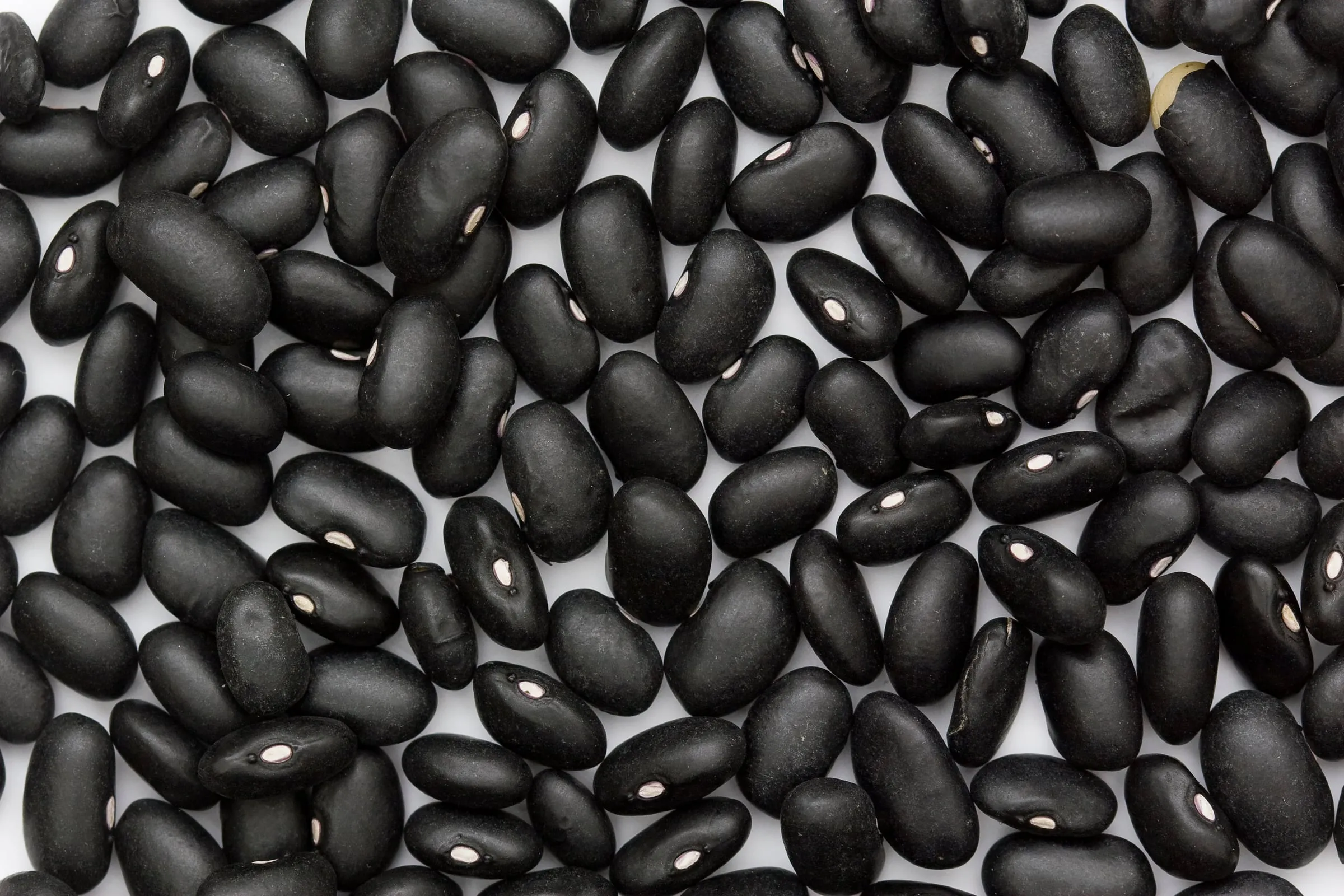 Dried black turtle beans, the base of this black bean veggie burger. Cook them, or use canned ones, then drain and rinse 300 g (10.6 oz) for five patties. (Photo: Sanjay Acharya, CC BY-SA 3.0, https://commons.wikimedia.org/wiki/File:Black\_Turtle\_Bean.jpg)
Black bean veggie burger, step by step
Dry the beans, mash, adjust the texture, chill, shape, then sear without flipping too soon. Every step either takes water out or adds structure. A veggie patty needs nothing else.
1. Dry the black beans in the oven
Spread the drained beans on a sheet pan and bake at 350 °F (175 °C) for about 20 minutes, until a dry skin forms and most skins have split. This is the López-Alt technique, as reported by Tasting Table and used by This Healthy Table. Twenty minutes now saves the center later.
2. Mash the beans with the sweet potato and rice
Put the dried beans, sweet potato and brown rice in a bowl and mash them with a fork or potato masher. Leave some beans partly whole, because a patty with some bite reads as a burger, while a smooth one reads as a spread. Season with salt and pepper.
3. Adjust the texture with breadcrumbs
Add breadcrumbs a spoonful at a time until the mix is moist but holds its shape when you press it. Directo al Paladar describes the goal as a dough that is “homogeneous, moist but moldable.” Too wet? More breadcrumbs or rolled oats. Too dry? A little oil or water.
4. Chill the mix for 30 minutes
Cover the bowl and refrigerate it for 30 minutes before shaping. The starches firm up as they cool, and a cold mix shapes cleanly and sears without slumping.
5. Shape 120 g patties with wet hands
Divide the mix into 120 g (4.2 oz) portions and shape them with wet hands so nothing sticks. Use a kitchen scale. Even patties cook at the same rate, and guessing by eye is how one patty burns while the next stays cold in the middle.
6. Sear until a golden crust forms
Heat a little oil in a skillet over medium-high heat and cook the patties for about 5 minutes per side. That’s This Healthy Table’s timing for its black bean burgers, and a sensible starting point. Don’t touch the patty until a golden crust has formed: that crust is what holds it together when you flip.
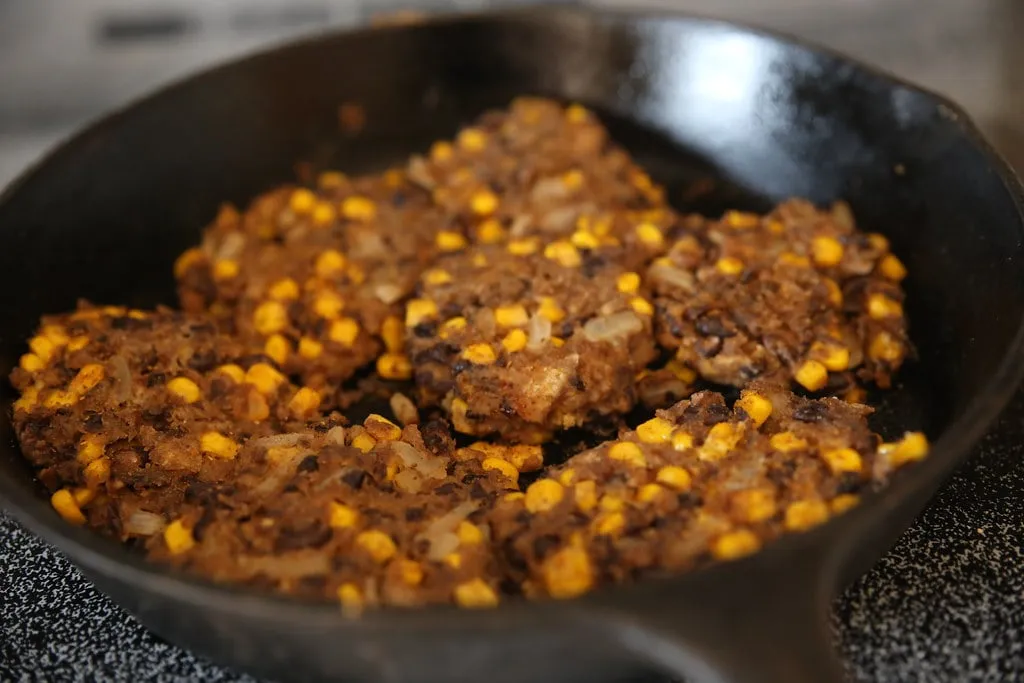 Black bean veggie burger patties searing in a cast-iron skillet. Leave them in place until a golden crust forms, about 5 minutes per side over medium-high heat, before you flip them. Illustrative photo: these patties contain corn and are not the ones from this recipe. (Photo: Carol VanHook (vanhookc), CC BY 2.0, https://www.flickr.com/photos/97651299@N00/14657242233)
7. Assemble the veggie burger
Toast the buns, then build the burger with your toppings and sauce. A tender patty wants a soft bun, so try our homemade brioche buns. For the classic lettuce, tomato, onion and pickle stack, borrow the build from our Whopper copycat recipe.
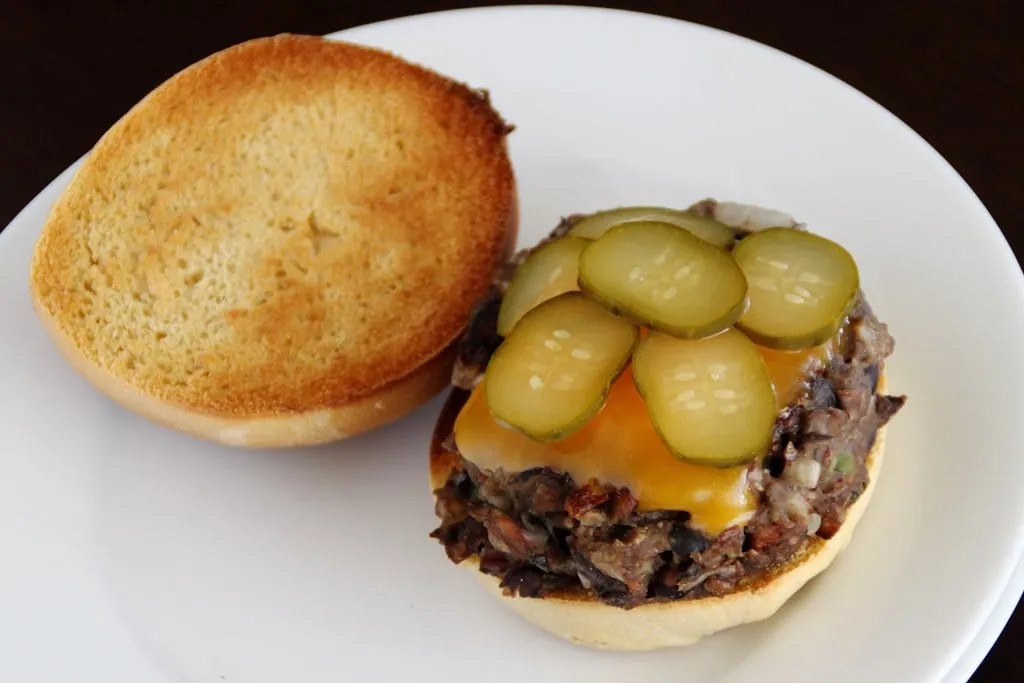 Assembling the veggie burger: toast the bun first, then add the black bean patty, a slice of melting cheese for umami and pickles. Illustrative photo of a jalapeño black bean burger, not this recipe. (Photo: Stacy Spensley, CC BY 2.0, https://www.flickr.com/photos/21001756@N06/4683790450)
Which beans make the best veggie burger? Comparing the bases
Black beans, chickpeas and lentils give almost the same protein per 100 g, so choose your base for flavor and calories, not protein. Rice and quinoa are there for structure. Cooked rice brings almost no protein. My pick stays black beans: they give the darkest, most burger-like patty, and the drying trick was worked out for them. If you’re counting calories, go with lentils.
| Base (USDA FoodData Central) | Protein per 100 g | Calories per 100 g | Role in the patty |
|---|---|---|---|
| Black beans, boiled, salted | 8.86 g | 132 kcal | Main base, the US standard |
| Chickpeas, boiled, unsalted | 8.86 g | 164 kcal | Main base |
| Lentils, boiled, unsalted | 9.02 g | 116 kcal | Main base, lightest in calories |
| Brown rice, long-grain, cooked | 2.74 g | — | Structure, little protein |
| Quinoa, uncooked | 14.1 g | 368 kcal | Structure; protein drops sharply once cooked |
Sources: USDA FoodData Central, entries 175237, 173757, 172421, 169704 and 168874, checked November 3, 2026.
Bar chart of protein per 100 g of veggie burger bases from USDA FoodData Central: boiled lentils 9.02 g, boiled black beans 8.86 g, boiled chickpeas 8.86 g, cooked long-grain brown rice 2.74 g, and uncooked quinoa 14.1 g (protein drops sharply once quinoa is cooked). Entries 175237, 173757, 172421, 169704 and 168874, checked November 3, 2026. (Chart: Burger Breton, data from USDA FoodData Central, public domain (U.S. government work))
Veggie burger variations: chickpea, lentil and vegan
To change the base, swap the black beans for the same weight of another cooked legume and keep the rest of the method. The drying step and the 30-minute chill apply to every version.
Chickpea burger
Use 300 g cooked chickpeas instead of the black beans. Protein is identical to black beans (8.86 g per 100 g), but calories are higher: 164 kcal against 132. Chickpeas are firmer, so mash them harder than you would beans.
Lentil burger
Use 300 g cooked lentils. At 9.02 g of protein and 116 kcal per 100 g, lentils are the leanest base in the table. In Spain and Argentina they’re the default, and black bean burgers are the exception.
Black bean burger with feta (US-style)
This Healthy Table’s version is richer: two 15-ounce cans of black beans (about 425 g each), 1 red onion, 1 red bell pepper, 3 garlic cloves, ½ cup feta, 2 tablespoons mayonnaise, 1 egg and ¾ cup panko, cooked in a skillet over medium-high heat for 5 minutes per side, for 6 to 8 burgers. My reservation: the egg does the binding, so it covers up the moisture problem instead of solving it. And it’s no longer vegan.
Egg-free and vegan veggie burger
The base recipe is already egg-free. Breadcrumbs and chilled starch do the binding, so the patties are vegan as long as your breadcrumbs and bun are. Two other egg-free binders come up: a flaxseed gel (ground flaxseed mixed with water) and a chickpea flour paste rested for about 10 minutes. I found each in only one source and haven’t tested either yet, so no quantities from me.
How much protein is in a homemade veggie burger?
Each 120 g patty in this recipe gets about 6 g of protein from the black beans and rice alone. More beans means more protein: a 120 g patty that is 70% cooked legumes (84 g) gives about 7.5 g from the legumes alone, before cheese, egg or tofu.
The math for the base batch, from the USDA values above: 300 g black beans give 26.6 g of protein and 120 g brown rice give 3.3 g, so 29.9 g across five patties. Sweet potato and breadcrumbs add a little more. I left them out because I don’t have sourced figures for them.
For a high-protein veggie burger, push the beans up and the starch down, or add cheese as the feta version does. Tofu, textured vegetable protein, seitan and seeds also add protein. I’ll add their numbers once I’ve checked them against a primary source.
Why your veggie burger falls apart or turns mushy
Water is almost always why a veggie burger crumbles or stays pasty. Too much and the patty never firms up. Too little and it cracks. Every independent source I read lands on the same fixes (Weber, This Healthy Table, Directo al Paladar).
| Problem | Likely cause | Fix |
|---|---|---|
| Mushy or pasty center | Wet beans or vegetables | Oven-dry the beans; squeeze grated or chopped vegetables dry |
| Mix too wet to shape | Not enough dry binder | Add breadcrumbs or rolled oats a spoonful at a time |
| Patty cracks when shaped | Mix too dry | Add a little oil or water |
| Patty breaks in the pan | Mix not chilled, or flipped too early | Chill 30 minutes; flip only after a golden crust forms |
Veggie burger toppings and sauces for umami
A veggie patty lacks the savory depth of beef, so the toppings have to supply the umami. Sautéed mushrooms, a little miso or soy sauce in the sauce, or a slice of melting cheese all do it. To taste a professional version before cooking your own, all four Hans im Glück restaurants in Stuttgart serve vegetarian and vegan burgers, as our guide to vegetarian burgers at Hans im Glück in Stuttgart details. The kids’ vegan burger, the Kleiner Glücksgriff, cost €6.90 when we checked on October 20, 2026.
If you also cook beef patties, the beef burger doneness and temperature guide covers the meat side of the grill.
Veggie burger FAQ
How do I keep my veggie burger from falling apart?
Take the water out and give the mix time to set. Oven-dry the beans at 350 °F (175 °C) for about 20 minutes, add breadcrumbs until the mix holds its shape, chill it for 30 minutes and flip only once a golden crust has formed.
Why is my veggie burger mushy inside?
The beans or vegetables were too wet. Drying the beans in the oven before mashing, the technique J. Kenji López-Alt popularized at Serious Eats, is the most reliable fix.
What is the best binder for a veggie burger?
Breadcrumbs or rolled oats are the simplest, and they keep the recipe egg-free. An egg binds harder, as in This Healthy Table’s recipe. Flaxseed gel and chickpea flour paste are vegan alternatives I haven’t tested yet.
Which legume is best for a veggie burger?
Black beans are the US standard and give a dark, meaty-looking patty. Chickpeas and lentils give almost the same protein, 8.86 g and 9.02 g per 100 g, and lentils are the lightest in calories.
Can I make a vegan veggie burger that holds together?
Yes. This recipe has no egg. Dried beans, chilled starch and breadcrumbs hold the patty together, so it’s vegan as long as your breadcrumbs and bun are.
Can I cook veggie burgers on the grill, in the oven or in an air fryer?
This recipe uses a skillet: medium-high heat, about 5 minutes per side. On a grill, use well-chilled patties and wait for a crust before flipping. Published oven and air fryer times vary too widely between sources, so I’ll add them once I’ve tested them myself.
Can I freeze veggie burger patties?
The sources I read disagree on freezing times and reheating, so I won’t give a method until I’ve frozen and reheated a batch myself. Until then, I’d shape and cook the patties on the same day.
Can you still call it a “veggie steak” in the EU?
Not for long. The EU Council adopted a text on June 29, 2026 that reserves about thirty meat terms, including “steak,” for meat products, with a three-year transition (Réussir, The Plant Base). “Burger” is still allowed for plant-based products as long as the plant origin is clearly stated.