MOS Rice Burger Kakiage Copycat Recipe
My home version of MOS Burger's Japanese rice burger: soy-brushed rice buns, a flat shrimp and squid kakiage and a shio-kombu sesame salt sauce.
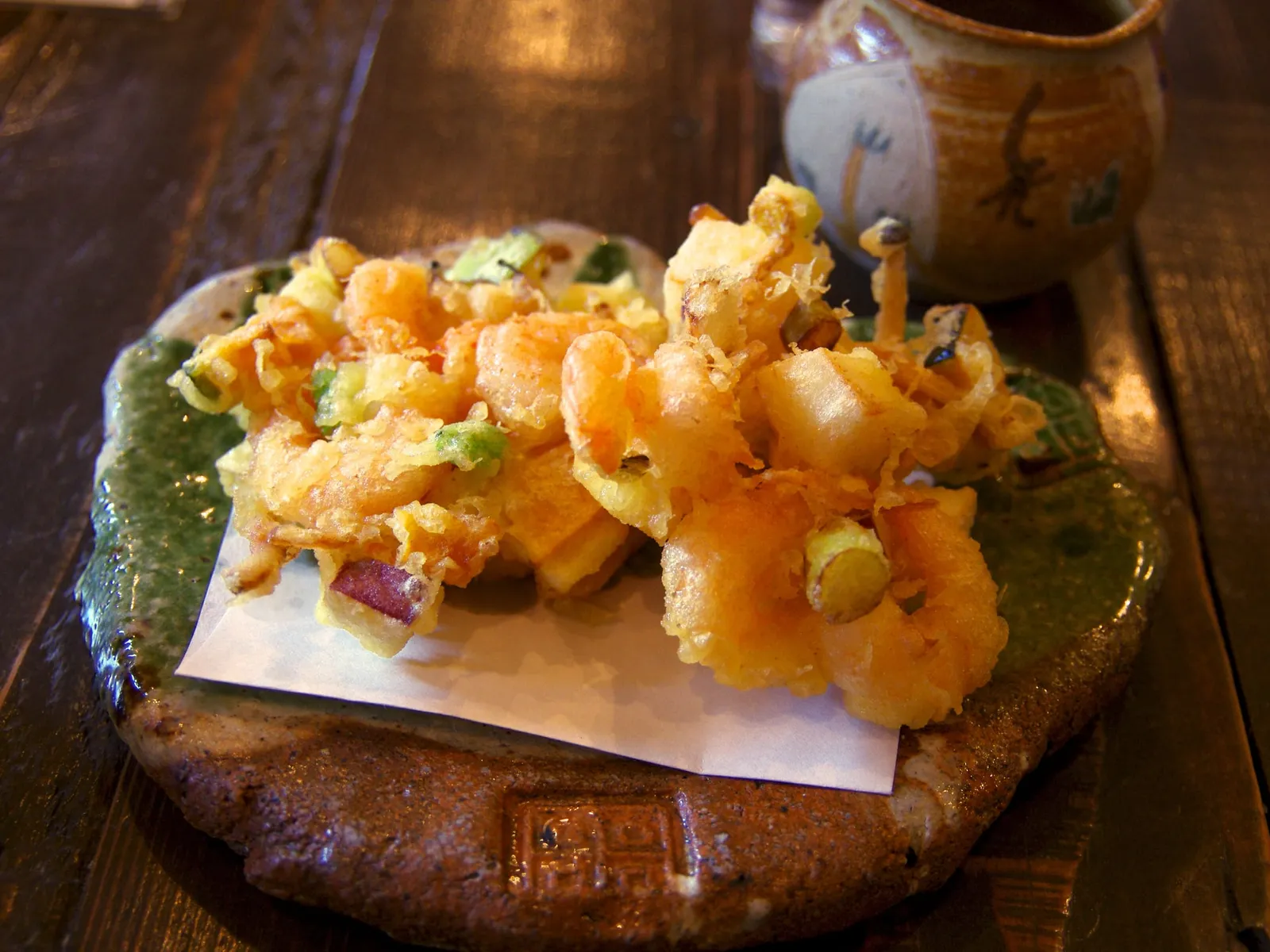
Photo: pelican from Tokyo, CC BY-SA 2.0
You can make the MOS Rice Burger Kakiage at home in about 50 minutes, not counting the time to cook the rice. This copycat recipe makes 2 burgers: four rice buns pressed in an 8 cm (3 in) ring, brushed with soy sauce and grilled, around a flat kakiage of shrimp, squid, onion, carrot and edamame fried at 180°C (355°F) and spooned with a sesame-oil and shio-kombu salt sauce. It is my home reconstruction, not MOS Burger’s official recipe. The chain has never published its sauce formula, its batter or the weight of each part, so where I had to guess, I say so.
What is in the original MOS Rice Burger Kakiage
The MOS Rice Burger Kakiage is a seafood fritter (kakiage) of squid, shrimp, onion, carrot and edamame, coated in a sesame-oil and shio-kombu salt sauce and held between two grilled rice buns. That is the composition MOS Burger gives on its official English menu, checked on November 6, 2026. Its full Japanese name is モスライスバーガー海鮮かきあげ(塩だれ): MOS Rice Burger seafood kakiage, salt sauce.
MOS says the rice buns are “brushed with soy sauce and grilled to maintain their shape, while also providing a crispy texture.” No lettuce or other fresh vegetable appears in the official documents for this product in Japan. Add some and you are making your own burger, not a copy. I leave it out: a spoonful of hot sauce turns lettuce limp before the first bite.
| The original in Japan (November 2026) | Official figure |
|---|---|
| Price | ¥510 including tax, per the official English menu (may vary by store type) |
| Weight | 183.0 g |
| Energy | 372 kcal |
| Protein | 8.5 g |
| Fat | 10.5 g |
| Carbohydrates | 61.3 g |
| Dietary fiber | 1.9 g |
| Salt equivalent | 1.9 g |
Sources: MOS official English menu and MOS nutrition table updated October 14, 2026.
The ingredients travel. According to MOS’s ingredient origin sheet of October 14, 2026, the rice buns are made in Japan with Japanese rice. The kakiage is made in China, with onion, carrot and edamame from China, shrimp from Pakistan and squid from Peru.
The price keeps climbing. All About recorded ¥400 in January 2023. A MOS Food Services press release moved it from ¥440 to ¥460 on March 19, 2025, and the official menu showed ¥510 in November 2026: 27.5% more than in 2023.
Line chart of the MOS Rice Burger Kakiage price in Japan, tax included: ¥400 in January 2023 (All About), ¥440 before March 19, 2025, then ¥460 (MOS Food Services press release), and ¥510 in November 2026 (official MOS English menu). That is a 27.5% rise in under four years. (Chart: Burger Breton, data from MOS Food Services (press release of March 3, 2025), MOS official English menu (November 2026) and All About (January 2023))
A short history of the MOS rice burger
MOS Burger launched the rice burger in 1987 to get Japan eating more of its own rice, turning the country’s staple food into a fast-food bun. The first one, according to Wikipedia, was the Tsukune Rice Burger, with a chicken meatball and daikon seasoned with soy. Today only two rice burgers remain on the permanent menu in Japan, per the October 14, 2026 nutrition table: this Kakiage (183.0 g, 372 kcal) and the Yakiniku (170.0 g, 353 kcal). The chain’s full story is on our MOS Burger brand profile.
MOS’s two permanent rice burgers in Japan, side by side (official nutrition table of October 14, 2026): Kakiage, 183.0 g and 372 kcal; Yakiniku, 170.0 g and 353 kcal. (Table: Burger Breton, data from the MOS Burger official nutrition table (mos.jp, October 14, 2026))
Ingredients for 2 MOS Rice Burger Kakiage
These quantities make 2 burgers, a little heavier than the original. The rice and starch ratio comes from published reproduction recipes. The kakiage and sauce proportions are my own estimates, because MOS does not publish them.
Rice buns (4 buns, 60 g each)
- 240 g (8.5 oz) cooked Japanese short-grain rice, still warm
- 2 tsp potato starch (katakuriko), or cornstarch
- 1 tsp toasted sesame oil, for the pan
- 2 tsp soy sauce, for brushing
Seafood kakiage (2 fritters)
- 40 g (1.4 oz) peeled raw shrimp, cut into 1 cm pieces
- 30 g (1 oz) cleaned squid, cut into 1 cm pieces
- 40 g (1.4 oz) onion, thinly sliced
- 20 g (0.7 oz) carrot, in fine matchsticks
- 20 g (0.7 oz) shelled edamame, thawed if frozen
- 40 g (1.4 oz) all-purpose flour, plus 1 tsp for dusting
- 5 g (1 1/2 tsp) potato starch
- 60 ml (1/4 cup) ice-cold water
- Neutral oil for frying, about 3 cm (1 1/4 in) deep in a small pan
Shio-kombu salt sauce (shio-dare)
- 4 g (1 heaped Tbsp) shio-kombu (salted kombu strips), finely chopped
- 1 Tbsp toasted sesame oil
- 1 Tbsp water
- 1 tsp sake or mirin
- 1 small pinch fine salt
How to make the rice buns for a Japanese rice burger
A rice burger bun is warm cooked rice mixed with a little starch, pressed hard into a ring and pan-grilled until a crust holds it together. Japanese reproduction recipes agree on the ratio: Sudachi Recipes and All About both use 1 Tbsp of potato starch for 360 g of cooked rice. All About presses 60 g of rice per bun in an 8 cm ring and cooks it 1 minute per side with sesame oil and soy sauce. I scaled that to 240 g for four buns, and I grill longer: a bun that cracks in the pan cannot be rescued, while an extra minute costs nothing.
Use Japanese short-grain rice (sushi rice works). Basmati or jasmine will not stick, and the bun falls apart. Press while the rice is still warm, with a wet ring and wet fingers, then let the buns rest a few minutes before they go in the pan.
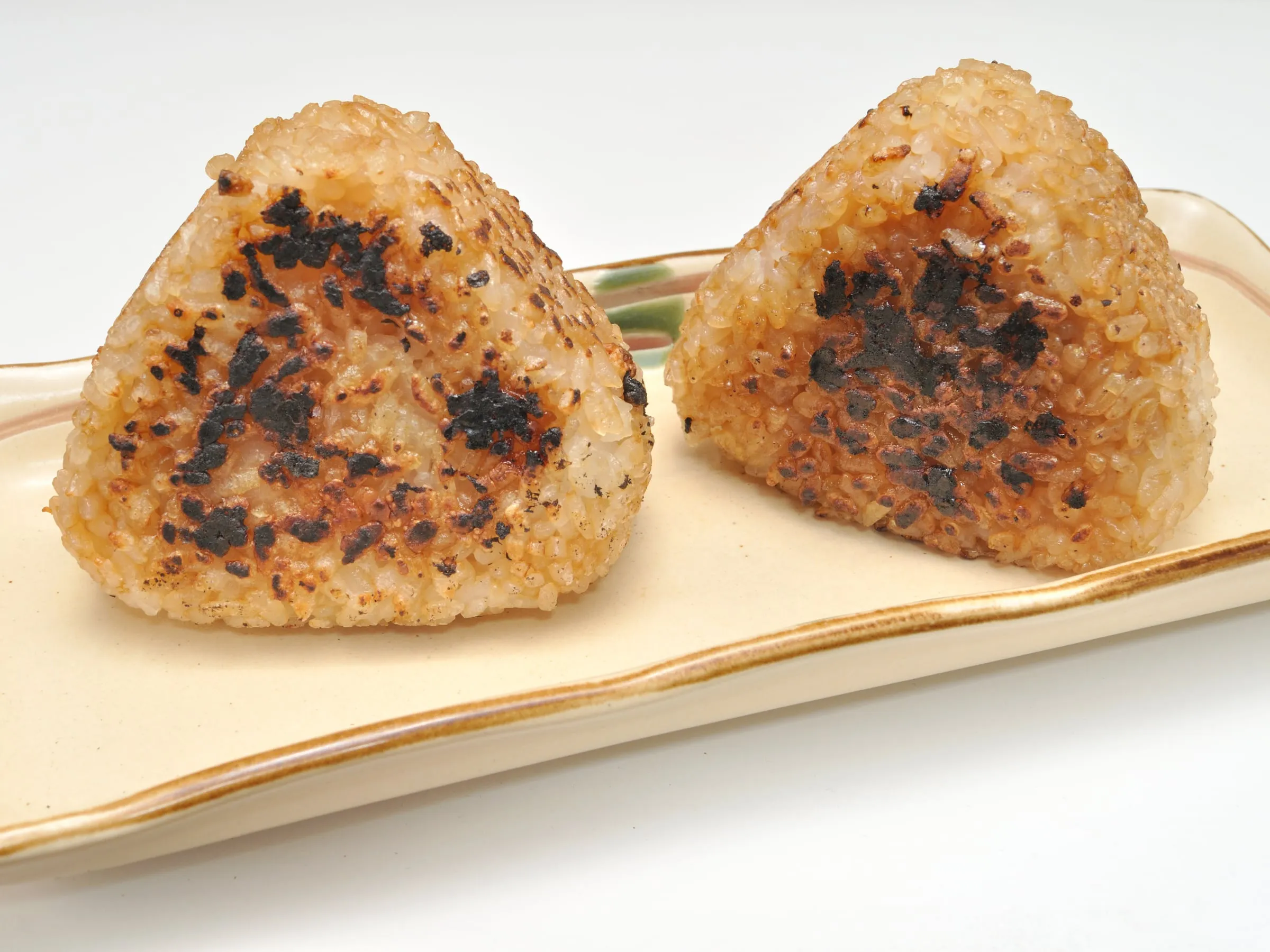 Two yaki onigiri, Japanese rice balls brushed with soy sauce and grilled until the crust browns and chars in spots. MOS uses the same soy-and-grill technique for its rice burger buns. Illustrative photo: these are triangular rice balls, not MOS buns (3770×2828) (Photo: Ocdp, CC0 1.0, https://commons.wikimedia.org/wiki/File:Yaki-Onigiri\_001.jpg)
How to make the shio-kombu sesame salt sauce
The salt sauce is toasted sesame oil carrying the salty, savory taste of shio-kombu, loosened with a little water and sake. MOS lists only sesame oil and shio-kombu for its 特製塩だれ (special salt sauce), so the sake, water and salt are my additions. Chop the shio-kombu very fine so it coats the kakiage instead of sitting on it in strips.
Shio-kombu is sold in Japanese and Asian grocery stores and online. No luck? Use 1/2 tsp kombu dashi granules plus a pinch of salt. You lose the chewy bits of seaweed but keep the taste of kelp.
How to fry a flat kakiage that fits a rice burger
A kakiage for a burger has to be flat and round, so fry it at 180°C (355°F) and slide it into the oil as a thin disc from a slotted spoon or flat spatula. That is the temperature Just One Cookbook uses for kakiage. Technique sources range from 170 to 180°C. I stay at the top of that range so the disc sets before it can spread.
Keep the batter ice-cold and mix it only a few strokes, lumps included; cold batter fries lighter. Don’t chase restaurant-tempura crunch, though. GIGAZINE described the original’s kakiage in May 2022 as moist and chewy (“munimuni”), not crispy, with a strong salty taste and a clear taste of edamame.
Step by step: MOS rice burger kakiage at home
The method runs in three parts: shape and grill the rice buns, fry the kakiage, then sauce and assemble. Count about 30 minutes of prep and 20 minutes of cooking, not counting the rice.
1. Shape the rice buns
I mix 240 g warm cooked rice with 2 tsp potato starch, then divide it into four 60 g portions. I press each one firmly into a wet 8 cm (3 in) ring on parchment, about 1.5 cm thick, and lift the ring away.
2. Grill and soy-brush the rice buns
I heat 1 tsp sesame oil in a nonstick skillet over medium heat and cook the buns about 2 minutes per side until a light crust forms. Then I brush the tops with soy sauce, flip, and give each side 30 seconds more so the soy toasts without burning. They wait on a rack, kept warm.
3. Mix the shio-kombu salt sauce
I stir the chopped shio-kombu, 1 Tbsp sesame oil, 1 Tbsp water, 1 tsp sake and a pinch of salt in a small bowl. It sits while I fry, so the kombu softens and seasons the oil.
4. Prepare the kakiage mix
I pat the shrimp, squid and edamame very dry, then toss them with the onion, the carrot and 1 tsp flour. That light dusting helps the batter grip the seafood.
5. Make the ice-cold batter
I whisk 40 g flour and 5 g potato starch, pour in 60 ml ice-cold water and stir a few strokes only. The seafood and vegetables go in right away, while the batter is still cold.
6. Fry the kakiage flat at 180°C (355°F)
I heat the oil to 180°C (355°F) and spread half the mix into an 8 cm disc on a slotted spatula. I slide it into the oil, fry about 2 minutes, flip, and fry 1 to 2 minutes more until golden. Then it drains on a rack while I fry the second disc.
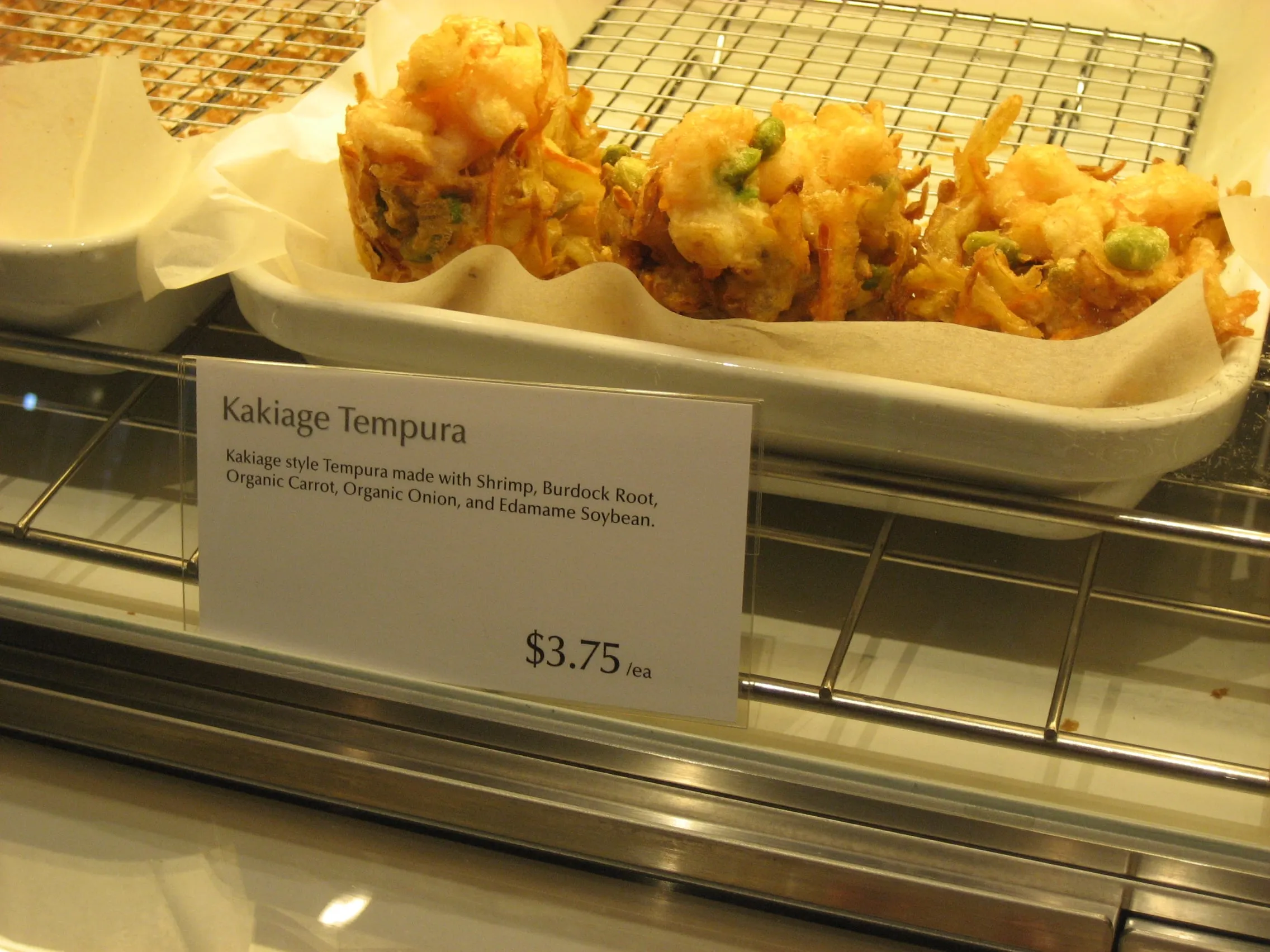 Kakiage fritters of shrimp, carrot, onion and edamame cooling on a rack at a Japanese deli in San Francisco in 2007. They share four of the five ingredients in the MOS filling, and you drain yours on a rack the same way. Illustrative photo, not taken at MOS Burger (2272×1704) (Photo: Wikidemon, Public domain, https://commons.wikimedia.org/wiki/File:Kakiage\_tempura.jpg)
7. Sauce and assemble
I spoon half the salt sauce over each hot kakiage, set it on a rice bun and close with a second bun. Eat it straight away. Five minutes later the bun has gone soft.
Why this recipe tastes like the original
This copy follows what MOS actually publishes: the five kakiage ingredients, a sauce built on sesame oil and shio-kombu, and Japanese rice buns brushed with soy and grilled. Four choices bring it closer.
- The size. GIGAZINE compared the original to an IC transit card, a little smaller than a regular hamburger. Two 60 g buns already weigh 120 g, so with its fritter each burger here comes out heavier than the original’s 183.0 g. For an exact match, use two-thirds of the kakiage mix.
- The crust. Grilling first and brushing soy at the end gives the crisp, soy-toasted outside MOS describes.
- The salt sauce. Finely chopped shio-kombu in sesame oil gives the strong salty, savory hit GIGAZINE noted.
- No lettuce. The original has no fresh vegetables, so this one has none either.
My take: the sauce matters more than the fritter. A crisp kakiage with a timid sauce is just a tempura sandwich, but a soft kakiage under plenty of shio-kombu tastes like MOS. If you have to cut a corner, cut it on the frying, never on the kombu.
Where to taste the original
The MOS Rice Burger Kakiage is a permanent item at MOS Burger in Japan. If you are traveling, our guides to MOS Burger in Tokyo, Osaka, Sapporo, Nagoya and Hiroshima list addresses and prices. For the other MOS classic at home, try my MOS Burger teriyaki burger copycat recipe, and find more in our burger recipes.
MOS rice burger kakiage FAQ
What is in the MOS Rice Burger Kakiage?
It is a kakiage of squid, shrimp, onion, carrot and edamame, coated in a sesame-oil and shio-kombu salt sauce, between two rice buns brushed with soy sauce and grilled. MOS lists no lettuce or other fresh vegetables for it in Japan.
What are MOS rice burger buns made of, and how do you stop them falling apart?
The official 2026 origin sheet lists Japanese rice, processed in Japan. At home, use warm short-grain rice, mix in potato starch (about 1 Tbsp per 360 g of cooked rice), press it hard in a ring and grill it until a crust forms before you add the soy.
What can I use instead of shio-kombu?
Use 1/2 tsp kombu dashi granules plus a pinch of salt in the sesame oil. You lose the chewy seaweed bits but keep the taste of kelp.
What temperature should I fry kakiage at?
Fry at 180°C (355°F). Just One Cookbook uses that temperature for kakiage, and technique sources range from 170 to 180°C. Slide the mix in flat from a slotted spatula so it sets as a disc that fits the bun.
Can I make the rice buns ahead?
Yes. I shape them, wrap them tightly and keep them in the fridge, then grill and brush them with soy just before serving. Rice firms up in the cold, so give the buns a little longer in the pan.
Is a rice burger gluten-free?
Not as written: soy sauce and the batter flour both contain wheat, and many shio-kombu brands are seasoned with soy sauce. For a gluten-free version, brush the buns with a tamari labeled gluten-free, make the batter with rice flour and check the shio-kombu label.
How much does the MOS Rice Burger Kakiage cost in Japan, and how many calories does it have?
It cost ¥510 including tax in Japan in November 2026, according to the official menu, and the price can vary by store type. MOS lists 372 kcal for a 183.0 g burger.
Where can I eat a MOS rice burger outside Japan?
MOS Burger also operates in Taiwan, Hong Kong, Singapore, Thailand, South Korea and the Philippines, according to MOS’s store data as of September 30, 2026 (see our MOS Burger brand profile). Menus differ by country, and I have not confirmed that any of them serves the Kakiage version.
Does it contain allergens?
Yes. Going by its ingredients, it contains at least shrimp, squid, wheat, soy and sesame. Check the full list in MOS’s official allergen sheet before you order in Japan.