McDonald's Hamburger Copycat Recipe at Home
One 1.6-ounce patty, ketchup, mustard, a pickle and rehydrated onions: how I rebuild the simplest burger on the McDonald's menu, with every guess marked.
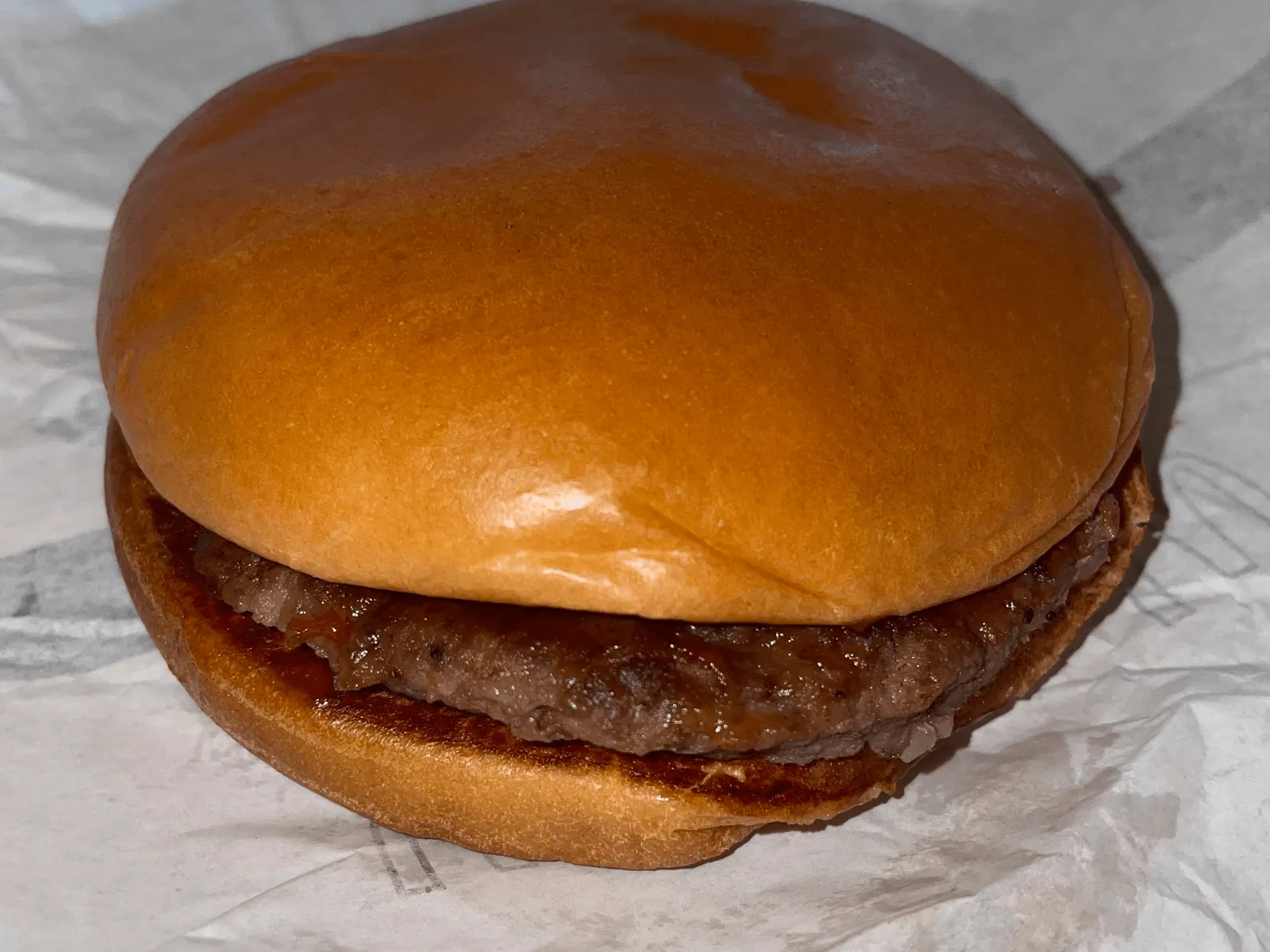
Photo: Filippos Fragkogiannis, CC BY-SA 4.0
To make a McDonald’s Hamburger at home, cook one thin 1.6-ounce (45 g) beef patty on a very hot griddle, and season it with salt and pepper only once it’s on the heat. Put it on a plain bun with ketchup, mustard, a dill pickle and rehydrated dried onions. That’s the whole burger. McDonald’s US lists exactly those ingredients, and press sources document the patty weight and the seasoning method. The griddle heat, the timings and the condiment doses are my own estimates, and I flag each one below. This is a homemade copycat, not McDonald’s official recipe.
What comes on a McDonald’s Hamburger?
A McDonald’s Hamburger in the US is one 100% beef patty seasoned with a pinch of salt and pepper, tangy pickles, chopped onions, ketchup and mustard, on a bun. That’s the list on the McDonald’s US Hamburger page. On November 4, 2026, the English page wouldn’t load, so I checked the same list on the Spanish-language US page: pickles, chopped onion, ketchup, mustard.
McDonald’s US says the burger has no artificial flavors, no preservatives and no colors from artificial sources. The pickles are the exception: according to the Spanish-language US page, they contain an artificial preservative.
What McDonald’s confirms and what I assume
The ingredient list, the patty weight, the salt-and-pepper seasoning and the rehydrated onions are on record. Everything else is mine. McDonald’s publishes no dose for the onions, pickles, ketchup or mustard, and no grill temperature, so I filled those gaps myself. The table shows which is which.
| Element | McDonald’s Hamburger (US) | My copycat version | Status |
|---|---|---|---|
| Patty | 1 × 100% beef patty, 1.6 oz before cooking (10:1, 10 to the pound) | 1 patty of 1.6 oz (45 g) per burger | Weight confirmed by press sources |
| Beef fat ratio | Not published | About 80/20 ground beef | Assumption |
| Seasoning | A pinch of salt and pepper, on the patty, never in the meat | Salt and pepper on the griddle | Confirmed; exact moment varies by source |
| Onions | Dehydrated onions rehydrated in water | 1 tbsp dried minced onion for 2 burgers, soaked 15 to 20 minutes in hot water | Method confirmed, dose estimated |
| Pickles | Pickles (plural on the US page; one slice in France) | 1 to 2 dill pickle chips per burger | Estimate |
| Ketchup and mustard | Listed, doses not published | 5 dots of ketchup and 5 of yellow mustard per burger | Estimate |
| Bun | Plain bun; toasting and recipe not confirmed in the US | Plain white hamburger bun, no sesame | Assumption |
| Cooking | Grill temperature not published | Griddle at 400 to 450°F (200 to 230°C), about 1 minute per side, to 160°F (71°C) inside | My recommendation |
What McDonald’s confirms vs what this copycat assumes: patty 1.6 oz (45 g, confirmed), 80/20 beef (assumption), salt and pepper on the griddle (confirmed), rehydrated onions (method confirmed, dose estimated), 1 to 2 pickle chips, 5 dots each of ketchup and mustard (estimates), plain bun (assumption), griddle at 400 to 450°F, 1 minute per side, 160°F inside (recommendation). (Table: Burger Breton, from McDonald’s US product page, The Takeout and Food Republic; data, no copyright)
How much does a McDonald’s Hamburger patty weigh?
A regular McDonald’s patty weighs 1.6 ounces, about 45 g, before cooking. That’s a tenth of a pound, the 10:1 format the chain uses for the Hamburger, the Cheeseburger and the McDouble, according to The Takeout and this analysis of the patty. Several copycat recipes that rank on Google, among them Mashed and Top Secret Recipes, use an eighth of a pound instead, about 57 g. I think that’s a mistake. The Hamburger has always been mostly bun, and 12 extra grams of beef tip it toward a generic diner burger.
Mashed also uses a sesame bun, 1 tablespoon each of ketchup and mustard, and 3 pickles. The Hamburger bun has no sesame in McDonald’s photos. And a full tablespoon of mustard on a 45 g patty? That’s a mustard sandwich. I use the same 1.6-ounce patty as in my McDouble copycat recipe, so the two recipes stay consistent.
McDonald’s Hamburger copycat ingredients (makes 2 burgers)
These amounts make 2 Hamburgers. Weigh the beef: on a patty this thin, an extra 10 g changes how it cooks. The onion, pickle and sauce doses are my estimates, because McDonald’s doesn’t publish them.
- 3.2 oz (90 g) ground beef, about 80/20, for 2 patties of 1.6 oz (45 g)
- 2 plain white hamburger buns, no sesame
- 1 tablespoon dried minced onion
- Hot water, enough to cover the onions
- 2 to 4 dill pickle chips
- Ketchup, about 10 small dots
- Yellow mustard, about 10 small dots
- Fine salt and ground black pepper
Equipment: kitchen scale, parchment paper, a flat griddle or cast-iron skillet, a stiff metal spatula and an instant-read thermometer.
Times: prep 20 minutes (the onions soak while you shape the patties), cooking about 3 minutes, total about 25 minutes.
How to make a McDonald’s Hamburger at home, step by step
Shape the patties thin, get the griddle hot enough to sear them in about a minute a side, and salt them only once they’re cooking. After that, it’s just assembly.
1. Weigh and shape the patties
Divide the beef into 2 portions of exactly 1.6 oz (45 g). Press each one thin and flat between 2 sheets of parchment paper, a little wider than the bun, because it shrinks as it cooks. Don’t put any salt or pepper in the meat.
2. Rehydrate the onions
Cover 1 tablespoon of dried minced onion with hot water and soak it for 15 to 20 minutes. Drain well and set aside.
3. Heat the griddle
Heat a flat griddle or cast-iron skillet to 400 to 450°F (200 to 230°C). McDonald’s doesn’t publish its grill temperature. I use this range because a patty this thin has to sear fast, or it dries out before it browns.
4. Cook and season the patty
Lay the patties on the griddle and press each one down for 3 seconds with the spatula. Sprinkle a pinch of salt and pepper on top while they cook. Cook about 1 minute per side, until the center reads 160°F (71°C).
5. Warm the buns
Warm the buns briefly so they’re soft and slightly warm. McDonald’s US doesn’t say whether it toasts the Hamburger bun. I leave mine soft, because that squashy bun is half the point, but toast the cut side on the griddle if you like a crisper crumb.
6. Dress and assemble
Put 5 dots of ketchup and 5 dots of mustard on each top bun, then half the onions and 1 or 2 pickle chips. Lay the patty on the bottom bun, close the burger and eat it right away.
Rehydrated McDonald’s onions: soak them, don’t chop them
The small, soft onions on a McDonald’s Hamburger are dehydrated onions that the crew rehydrates in water in the restaurant, Food Republic reports. The exact restaurant method isn’t published, and home advice ranges from 15 minutes to 2 hours. Two options:
- Fast: about 15 minutes in warm water, per Chowhound. Chowhound also notes that 2 tablespoons of dried onion equal roughly one medium fresh onion.
- Slow: about 2 hours in cold water in the fridge, the tip from Mike Haracz, a former McDonald’s corporate chef, quoted by Food Republic.
I stick to 15 to 20 minutes in hot water, as in my McDouble recipe. The onions come out soft and mild, and the burger is ready in under half an hour. Don’t swap in fresh chopped onion. It makes a sharper, crunchier burger, and that’s no longer the Hamburger.
Does McDonald’s season its patties?
Yes, with salt and pepper only, and never inside the meat. The Takeout says the patties are seasoned on the grill, while the UK page lists beef ‘with a little salt and pepper added to season after cooking’. The timing may differ by market. I season during cooking. The reason is texture: salt mixed into ground beef firms it toward sausage, while salt on the surface leaves the patty loose.
Safe internal temperature for a thin burger patty
Cook ground beef to 160°F (71°C) in the center, the USDA safe minimum. One minute per side is where I start with a 1.6-ounce patty. It’s not a guarantee, so check with a thermometer. My burger patty internal temp guide shows how to probe a patty this thin.
Why this recipe tastes like the original Hamburger
It sticks to what McDonald’s and the press document: the 1.6-ounce patty, salt and pepper on the surface only, rehydrated dried onions, and nothing but ketchup, mustard and pickle on top. The small patty keeps the original’s proportions, with a lot of soft bun for very little beef. There’s no cheese and no sauce to hide behind. Ketchup brings the sweetness, mustard the sharpness, and together they carry the whole flavor.
The Daily Meal ranks the Hamburger last of the McDonald’s burgers and calls it ‘dry and starchy’. I only half agree. ‘Starchy’ is the design, not a flaw. ‘Dry’ is mostly a holding problem, and at home it goes away if you eat the burger straight off the griddle, with a patty seared fast and not cooked a second past 160°F (71°C).
McDonald’s Hamburger vs Cheeseburger vs McDouble
The Hamburger is the base: one 1.6-ounce patty and no cheese. The Cheeseburger adds a slice of American cheese to the same single patty. The McDouble doubles the patty and keeps one slice of cheese. All three use the same 10:1 patty.
| Burger | Patties | Cheese | Toppings and sauces |
|---|---|---|---|
| Hamburger | 1 × 1.6 oz | None | Pickles, chopped onions, ketchup, mustard |
| Cheeseburger | 1 × 1.6 oz | 1 slice of American cheese | Pickles, chopped onions, ketchup, mustard |
| McDouble | 2 × 1.6 oz | 1 slice of American cheese | Pickles, rehydrated onions, ketchup, mustard |
McDonald’s Hamburger vs Cheeseburger vs McDouble: one 1.6 oz patty and no cheese, one 1.6 oz patty with cheese, two 1.6 oz patties with one slice of American cheese. All three use the same 10:1 patty. (Table: Burger Breton, from The Takeout and McDonald’s US; data, no copyright)
For the McDouble build, follow my McDouble copycat recipe. If you want the lettuce, tomato and mayo version with two patties, try the Daily Double copycat recipe.
Is the McDonald’s Hamburger the same in the US, France and the UK?
The idea is the same everywhere: one beef patty with pickle, onions, ketchup and mustard. The official wording differs by country, though. Here’s what each market’s product page stated on November 4, 2026.
| Market | What the official page states |
|---|---|
| United States | 100% beef patty seasoned with a pinch of salt and pepper, pickles, chopped onions, ketchup, mustard; no artificial flavors, preservatives or colors from artificial sources, except the pickles |
| France | A beef patty, one pickle slice, onions, mild mustard (‘moutarde douce’) and ketchup; the bun is made with flour from the Label Rouge wheat supply chain (mcdonalds.fr) |
| United Kingdom and Ireland | Regular bun, 100% beef patty with salt and pepper added after cooking, 100% white onions, pickle slices, ketchup with 66% tomato puree, mustard with 13% mustard seeds (mcdonalds.com/gb) |
McDonald’s Hamburger in the US, France and the UK, from each official product page checked November 4, 2026: the US lists pickles; France lists one pickle slice, mild mustard and a Label Rouge wheat bun; the UK lists salt and pepper after cooking, 66% tomato puree ketchup and 13% mustard-seed mustard. (Table: Burger Breton, from McDonald’s US, France and UK product pages; data, no copyright)
Cooking for someone who grew up on the French version? Use a single pickle slice and a mild mustard. McDonald’s doesn’t name its mustard brand or formula in any market, so pick a mild yellow one.
The 15-cent burger: where the McDonald’s Hamburger comes from
The Hamburger has been on the menu since McDonald’s reopened in San Bernardino, California, in 1948 with its Speedee Service System, priced at 15 cents. That first menu had a hamburger, a cheeseburger, soda, milk, coffee, chips and pie, according to The Daily Meal. Food Republic dates the 15-cent burger to 1940 instead. For the bigger story, read our history of the hamburger.
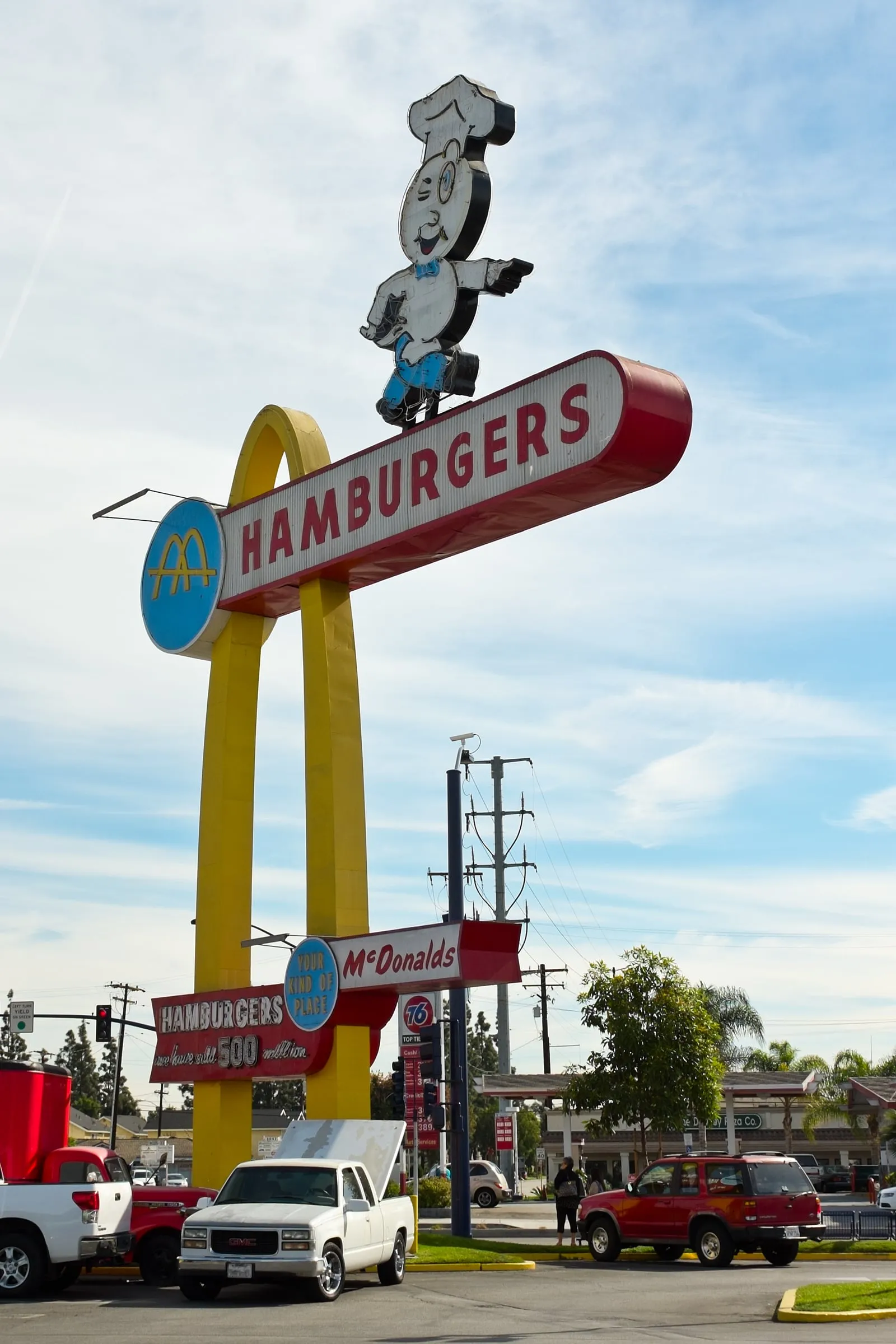 The 1953-style McDonald’s ‘Hamburgers’ sign with the Speedee chef mascot and the original single golden arch, at the oldest operating McDonald’s, 10207 Lakewood Boulevard in Downey, California. Speedee is named after the Speedee Service System that launched the 15-cent hamburger in San Bernardino in 1948. This is Downey, not the San Bernardino restaurant. (Photo: Northwalker, CC0 1.0, https://commons.wikimedia.org/wiki/File:Historic\_Downey\_McDonalds\_Hamburgers\_Sign.jpg)
How much does a McDonald’s Hamburger cost in 2026?
A McDonald’s Hamburger costs about $2.40 to $3.20 in the US in 2026, depending on the restaurant, per The Daily Meal. It’s still on the 2026 US burger menu, next to the Big Mac, the Quarter Pounders, the McDouble, the Daily Double, the Cheeseburger and the Double Cheeseburger. See new McDonald’s burgers in 2026 for the rest of the lineup, and the Big Mac Index 2026 for prices around the world.
Bar chart, McDonald’s Hamburger price in the US: $0.15 in 1948 (San Bernardino, Speedee Service System) vs about $2.40 to $3.20 in 2026 depending on the restaurant, shown as a range bar. Source: The Daily Meal. (Chart: Burger Breton, data from The Daily Meal (2026); data, no copyright)
McDonald’s Hamburger calories and nutrition
A US McDonald’s Hamburger has 250 calories, 9 g of fat, 30 g of carbohydrates and 12 g of protein, per McDonald’s US and FatSecret. These are the restaurant’s figures, not those of the homemade version, which depend on your bun and your beef.
Bar chart, McDonald’s Hamburger nutrition facts (US, 1 burger): 250 calories, 30 g carbohydrates, 12 g protein, 9 g fat. These are the restaurant’s figures, not the homemade copycat’s. (Chart: Burger Breton, data from McDonald’s US and FatSecret; data, no copyright)
It’s also the burger in the US Hamburger Happy Meal, served with small fries, 1% low-fat milk and apple slices, for 475 calories in total.
McDonald’s Hamburger copycat FAQ
What comes on a McDonald’s Hamburger? One 100% beef patty seasoned with salt and pepper, pickles, chopped onions, ketchup and mustard on a bun, as listed by McDonald’s US.
How big is a McDonald’s Hamburger patty? 1.6 ounces (about 45 g) before cooking, a tenth of a pound. Copycats that use an eighth of a pound (about 57 g) make the patty too big.
How many calories are in a McDonald’s Hamburger? 250 calories in the US, with 9 g of fat, 30 g of carbohydrates and 12 g of protein.
What is the difference between a Hamburger and a Cheeseburger at McDonald’s? Cheese. Both use one 1.6-ounce patty; the Cheeseburger adds a slice of American cheese and the Hamburger has none.
How do you make McDonald’s onions at home? Soak dried minced onion in hot water for 15 to 20 minutes, then drain. A former McDonald’s corporate chef suggests about 2 hours in cold water in the fridge instead.
Does McDonald’s season its patties? Yes, with salt and pepper on the patty, during or after cooking depending on the source, never mixed into the meat.
Which ketchup and mustard should I use? A classic tomato ketchup and a mild yellow mustard. McDonald’s doesn’t publish its brands or recipes; only the UK page gives details (66% tomato puree in the ketchup, 13% mustard seeds in the mustard).
Is the bun toasted? McDonald’s US doesn’t say. I just warm mine and keep it soft; toast the cut side if you want a crisper crumb.
Is the McDonald’s Hamburger the same in France and the US? Close, but not identical: France lists a single pickle slice, a mild mustard and a bun made with Label Rouge wheat flour.
How much did the first McDonald’s hamburger cost? 15 cents when McDonald’s switched to the Speedee Service System in San Bernardino in 1948.
More McDonald’s and fast-food copycat recipes
If you like small, simple burgers, try the Burger King cheeseburger copycat, the Five Guys Little Cheeseburger copycat or the Dairy Queen Original Cheeseburger copycat. Read the chain’s full story on our McDonald’s brand profile, or browse every recipe in the Burger Breton recipes section.